
Question: I have a summer-blooming overgrown shrub that has been neglected for years. How and when do I prune the shrub without harming it?
By Bethanne Criqui, Piedmont Master Gardener
Pruning can seem complicated and overwhelming, but it does not need to be! It should be a regular part of caring for most shrubs and involves the selective removal of branches and other parts of the shrub. Pruning can be used to remove diseased, dead or unsightly plant material, improve the appearance and health of the plant, control plant size, structure and shape, encourage vegetative growth and flowering and rejuvenate old plants.
When to Prune
There is no bad timing for pruning dead, diseased, damaged stems or double-crossed branches. In other words, “remove the bad stuff” whenever dead or diseased material catches your eye and when you prune for other reasons. It may also be necessary to remove branches that could injure people or damage property.
In other cases, the time to prune depends on the plant’s flowering, fruiting and growth habit.
Summer-blooming shrubs that flower on new wood (current year growth) should be pruned in late winter or early spring before the “bud break” (when buds swell and open) or immediately after flowering. Examples of summer-flowering shrubs common to Central Virginia include abelia, beautyberry, and summersweet. However, because some summer-flowering shrubs, including some types of hydrangeas, bloom on old wood, be sure to identify the species or cultivar to determine if the plant blooms on new or old growth and apply the appropriate pruning method.
Spring-flowering shrubs (blooming before late June) form their buds during the previous season on old wood and should be pruned right after flowering to avoid removing buds that are about to bloom. Central Virginia spring-flowering shrubs include forsythia, azaleas, rhododendrons, and lilacs. Summer-
blooming shrubs that flower on old wood should also be pruned after flowering.
Unless the shrubs are dead or diseased, do not prune spring-or summer blooming shrubs in late summer or early fall to avoid winter damage which can reduce the next year’s floral display.
Renewal or rejuvenation pruning, a more drastic technique to restore a shrub’s normal shape and size, should be done in late winter or early spring before new growth appears.
For the timing of pruning for specific shrubs, see the Virginia Cooperative Extension’s shrub pruning calendar.
How to Prune
There are two basic types of pruning cuts: heading cuts and thinning cuts.
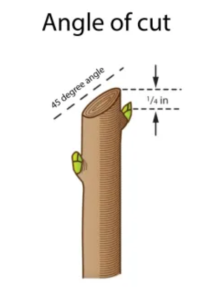
Image source: U C Marin Master Gardeners
Heading cuts are used to remove the top of a branch back to a bud. These cuts can cause more vigorous flowers and fruits on remaining branches, help control the shape of the plant and make the shrub denser. Heading cuts involve cutting a stem back to about one-quarter inch above a bud at a 45-degree angle that slopes down and away from the bud. Before making heading cuts, step back and consider where you want new growth. The direction the bud faces will determine the direction of the new branch growth. Done correctly, heading cuts reduce the height of the shrub while retaining its natural shape.
Thinning cuts are used to remove an entire branch at its point of origin on the main trunk or branch of the shrub. Make cuts just above the point where the branch to be removed joins the main trunk or a larger branch. These cuts are used to open up the shrub to more light and air circulation, reduce density and promote healthy growth of the shrub. Be careful not to remove the branch collar, which is the enlarged, raised “neck” where the branch meets the trunk or another branch. The branch collar grows over and seals wounds caused by these cuts.
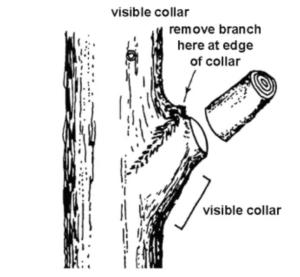
Image Source: UC Marin Master Gardeners
Wound dressing or paint should not be applied to cuts because it does not promote healing or prevent decay.
Shaping the shrub
Consider the shrub’s basic growth habit (shape, size and structure) when deciding how to prune it.
- Mounding type shrubs have a rounded crown and a wider base. Use thinning cuts to remove the longest branches, making the cuts inside the shrub. Thinning up to one-third off this type of shrub will still allow it to keep its shape.
- Cane-type shrubs have multiple upright stems (canes) growing from the center of the plant or directly from the crown or roots. Remove the tallest canes near the ground level, then thin out any crossing canes (canes that touch other canes, which may rub and cause wounds.)
- For tree-like shrubs, use thinning cuts to open up the center of the shrub to sunlight and airflow. Next, prune branches close to the ground and root suckers. Finally, make heading cuts, carefully removing about one-eighth to one-quarter of branches.
Renewal or Rejuvenation Pruning: All at Once or Over Time?
This type of pruning can restore a shrub’s appearance and keep it compact. Renewal pruning can be done all at once or over several years. Prune in late winter or early spring before bud break.
As a first step, research whether the shrub is likely to respond well to drastic pruning. Note that severe rejuvenation may reduce or eliminate flowering for one or more years but may be necessary for the plant’s survival. Make sure that the shrub is healthy enough, planted in a good location with enough space for the mature shrub.
- One method is to remove the entire shrub to a height of six to ten inches above the ground. This would stimulate growth of buds closest to the wound. Prune to retain outward pointing buds to encourage outward facing growth and ensure that the inner portion of the shrub does not become too dense. This method is not suitable for a number of overgrown conifers and other shrubs that cannot regenerate old leafless stems. In these cases, selective removal of old stems gives better results.
- Another approach is to remove growth over three years. Remove one-third of the oldest and weakest branches in the first year; one half of the remaining old branches in the second year; and prune the rest of the old branches in the third year. Although it takes longer, the shrub will look better during the pruning process.
Some well-known shrubs that tolerate extensive rejuvenation include spirea, abelia, forsythia, beautyberry and flowering quince.
Use the Right Tools
Depending on the specific shrub, bypass hand pruners, lopping shears, pruning saws and pole pruners are recommended for pruning jobs. Use quality tools and disinfect your tools between plants and after pruning. Keep blades sharpened and oil them after use.
More Information
To dive deeper into pruning techniques, check out these general guidelines. Want to add more flowering shrubs to your garden? Find recommendations for showy and problem-free shrubs for the Virginia landscape.
References
“A Guide to Successful Pruning: Pruning Basics and Tools”, French, Susan C., Extension Technician and Appleton, Bonnie L., Extension Horticulturist, Virginia Tech, Virginia Cooperative Extension, Publication 430-455, 1994.
“A Guide to Successful Pruning: Pruning Shrubs”, French, Susan C., Extension Technician and Appleton, Bonnie L., Extension Horticulturist, Virginia Tech, Virginia Cooperative Extension, Publication 430-459, 2009.
“A Guide to Successful Pruning, Shrub Pruning Calendar, “French, Susan C., Extension Technician and Appleton, Bonnie L., Extension Horticulturist, Virginia Tech, Virginia Cooperative Extension, Publication 430-462,2009.
“General Pruning Techniques: Pruning Trees and Shrubs”, Fair, Barbara, North Carolina State Extension Office, Publication AG-780-03, 2020.
“Horticulture at Home: Summer Pruning – The Why and How-to”, Elder, Wesley, Matthaei Gardens and Nichols Arboretum at University of Michigan, 2026.
“How – And When – to Prune Hydrangeas”, Stroupe, Chris, Piedmont Master Gardeners, The Garden Shed, Vol 12, No 10, Oct 2026.
“How and When to Prune Flowering Shrubs”, Ryan, Barb, Master Gardener, Penn State University, Penn State Extension, 16 Sep 2026.
“Pruning Large, Overgrown Shrubs”, Jauron, Richard and Steil, Aaron, Iowa State University, Iowa State University Extension, 2026.
“Pruning Shrubs and Hedges in the Home Garden”, University of Maryland, University of Maryland Extension, 14, Sep 2023.
“The When, Why, and How to Prune Shrubs”, Nuhn, Paul, Extension Master Gardener, Master Gardeners of Northern Virginia, 9 Feb 2022.