At our horticultural help desks we get a lot of questions about pruning hydrangeas. And no wonder: hydrangeas are popular, common, and beautiful, and grow very well in Virginia. Like most ornamentals, hydrangeas benefit from regular pruning. In particular, hydrangeas must be pruned properly to produce lots of flowers.
The first step in pruning hydrangeas is determining which kind of hydrangea you have. Identification is key because the flower buds of different hydrangea species develop at different times, and this determines when and how to prune. There are four hydrangeas commonly found in home gardens.
Bigleaf hydrangea (Hydrangea macrophylla)
These are the plants, native to eastern Asia, that most people imagine when they think of hydrangeas. Their flowers usually form a ball (above and below right), though the flowers of “lacecap” varieties are flat (below left and center). The flowers are famously pink or blue, depending on soil acidity, but some cultivars are white. Leaves are in an opposite arrangement, have serrated edges, and are elliptical or egg-shaped, usually with a pointed tip (see photos below).
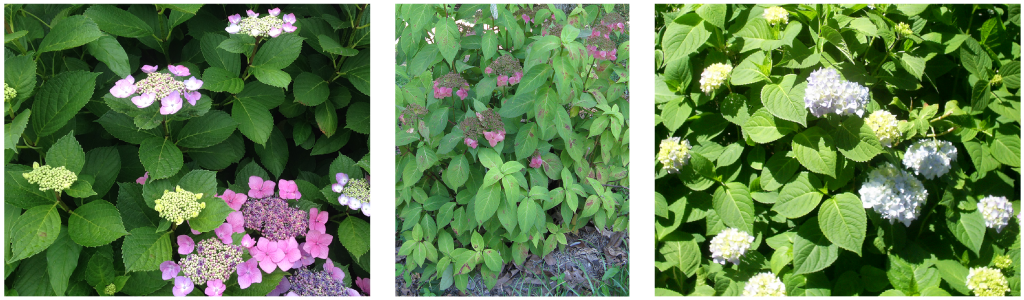
Center: Bigleaf hydrangea with elliptical leaves, narrower than those to the left. Photo: KENPEI. CC BY-SA 3.0 (cropped, sharpened)
Right: Bigleaf hydrangea with egg-shaped leaves, wider at the base. Photo: Andersreilund. CC BY-SA 4.0 (cropped)
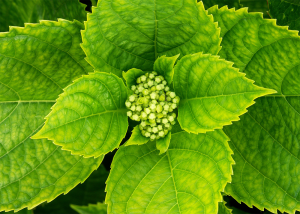
Bigleaf hydrangeas bloom on “old wood”. In other words, the flower buds that develop this year won’t bloom until next year. This means that if you cut off flower buds – which are at the tips of the stalks (see photo to right and drawing below) – in winter or spring, the plant won’t bloom that summer. Therefore, prune bigleaf hydrangeas in the summer, as soon as their flowers begin to age and lose color. Prune just above a node, i.e. the areas along the stalk where new growth forms (see drawing), cutting at a 45° angle.
Pruning in the summer will trigger growth at the nodes below the cut. Summer growth will allow new flower buds to develop before winter. These buds will bloom the following year.
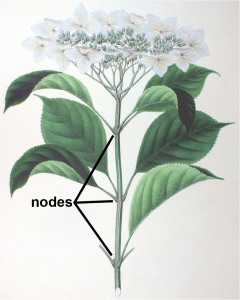
It’s not necessary to prune at the outermost node, i.e. the one just below the flower. Repeated pruning at the end of a stalk promotes growth at the outermost nodes, resulting in a leggy plant that might outgrow the spot where it’s planted. For a smaller, tighter plant, prune a couple feet off the ground – but always just above a node.
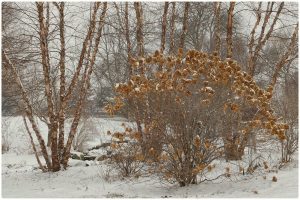
There are complications, of course. It’s common to leave brown, dried-up blooms on hydrangeas over winter, a practice called “antiquing.” Antiquing creates an attractive winter display (see photo below), but it prevents flowering in the following year: without pruning, there’s no growth at the nodes below the flower. Instead, the flower will fall off in the spring or summer – or you can cut them off yourself – and only then will new flower buds develop, to bloom the next year. My advice is to antique at most a third of the blooms, and cut off the rest when the flowers start fading.
Why a third, not a half? This brings us to the next complication. Once a stalk is four or five years old, it’s less likely to flower, and its flowers will be smaller. The solution is to cut these older stalks down to the ground. New stalks will sprout from the base of the plant and will – in future years of course – bloom more vigorously. This practice has two other advantages: it helps solve the legginess problem mentioned above, and it opens up the inside of the plant for better airflow, keeping the leaves dry and reducing fungal diseases.
Putting all this together, here is a suggested scheme for pruning bigleaf hydrangeas:
- When flowers start to fade in mid- or late summer, cut a third of them off.
- Leave a third of the flowers to antique over the winter. Cut them back to a node the following spring, or let them fall off on their own.
- Cut a third of the stalks all the way to the base. Choose the oldest, least productive stalks.
Finally, modern breeders have developed bigleaf hydrangeas that bloom on both old and new wood. In other words, some of their flower buds bloom in the same year they appear. This simplifies pruning considerably: you can wait until late winter to prune, and in some climates you might get multiple rounds of flowering as new flower buds develop and bloom. When planting new hydrangeas, these cultivars are a good choice.
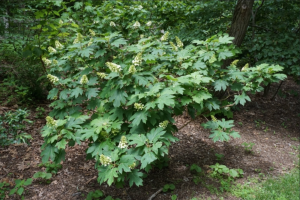
Oakleaf hydrangea (Hydrangea quercifolia)
These hydrangeas have leaves that, well, look like oak leaves. Flowers are arranged in a panicle, a conical form around a central stem. The initial blooms are white, typically turning a little pink as the flowers mature. They’re native to the southern US, but most commercial cultivars are hardy as far north as zone 5.
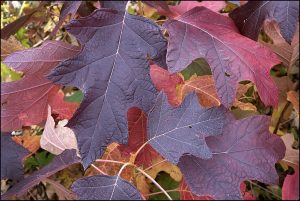
Oakleaf hydrangeas also bloom on old wood, so prune them like bigleaf hydrangeas. The only real difference between pruning oakleaf and bigleaf hydrangeas is aesthetic. Oakleaf hydrangeas naturally have an open, tree-like growth habit (see picture), so they look best when allowed to grow a little taller and looser than bigleaf hydrangeas. This also will make their beautiful fall foliage more visible (see picture). To achieve this effect, prune minimally: remove flowers once they begin to fade, and only occasionally cut back older and less productive stalks.
Panicle hydrangea (Hydrangea paniculata)
These Asian hydrangeas also have flowers arranged in panicles. Like oakleaf hydrangeas, their flowers are initially white and become pink as they mature. Leaves are opposite, with serrated edges, elliptical or egg-shaped, and slightly pointed. Location might also be a clue to identification: panicle hydrangeas are more tolerant of full sun than other hydrangeas.
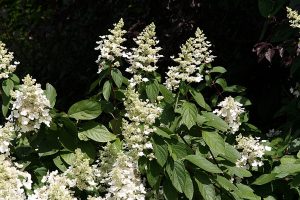
Panicle hydrangeas bloom on new wood. This means that you can prune them in winter or early spring like most other trees and shrubs. New growth will appear in the spring, and will set buds and blossom that summer.
There are two main methods of pruning panicle hydrangeas. The first option is a hard pruning, to about a foot off the ground. Cutting back close to the ground results in vigorous growth in the spring, as much as 8 feet in optimal conditions. This new growth can be thin and flexible. The second option is a lighter trim, to 3 to 5 feet high. This will result in only 2 to 3 feet of growth, usually with thicker stalks.
The choice mostly depends on the kind of blooms a particular plant develops. Some panicle hydrangeas have very dense and showy blossoms. Such blossoms can be quite heavy, particularly after a rain. If your panicle hydrangea has this kind of blossom, the lighter pruning option, which results in a sturdier plant, is probably the best choice. On the other hand, some panicle hydrangeas develop looser, more open blooms. These plants can be pruned closer to the ground because their lighter blossoms won’t cause the resulting tall, thin stalks to droop.
Observe your plants and imagine how different growth habits resulting from different pruning methods will look in their location.
Smooth hydrangea (Hydrangea arborescens)
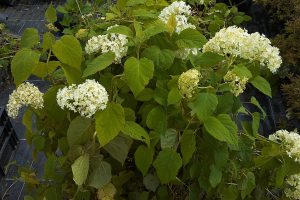
Despite the name, smooth hydrangeas – which, like oakleaf hydrangeas, are native to the southeastern US – have leaves with serrated edges. Leaves are usually more heart-shaped than elliptical (see picture). Flowers are in a flat arrangement, i.e. a lacecap, or form a slightly flattened sphere. Most smooth hydrangeas have white flowers, but some modern varieties are pink. Unlike bigleaf hydrangeas, flower color doesn’t depend on soil acidity.
Alert readers will note that this description sounds a lot like bigleaf hydrangeas. The critical difference between smooth and bigleaf hydrangeas is that smooth hydrangeas, like panicle hydrangeas, only flower on new wood. Thus, you can observe your plants after pruning and see if blooms appear the next year, in which case you have a bigleaf hydrangea, or in the same year, in which case your plant is a smooth hydrangea – or a bigleaf hydrangea that blooms on new wood, as described above.
Prune smooth hydrangeas close to the ground. Since they flower on new wood, you can prune them in winter or early spring.
Concluding thoughts
There are a couple of non-pruning practices that will help hydrangeas to flower. First, avoid excessive nitrogen fertilizer, which promotes leafy growth at the expense of flowering. Instead, use a balanced fertilizer like 8-8-8, applied early in the year; Clemson University recommends fertilizing in March, May, and July. Second, protect flower buds from cold. This is particularly important for bigleaf and oakleaf hydrangeas, because they bloom on old wood. In particular, cover hydrangeas if there’s a late frost after the plants leave dormancy. Some growers in northern climates go so far as to pile leaves over their hydrangeas before winter, surrounding them with a low fence to keep the leaves in place.
And finally, a few general tips for successful pruning: it’s OK to remove dead or diseased branches from any tree or shrub at any time of year. Don’t cover cut ends with shellac or tar, which will only prevent the natural healing processes of the plant. And finally, take good care of your pruning tools: keep them sharp, and disinfect them with rubbing alcohol to avoid spreading fungal diseases between plants.
References and further reading
Bigleaf hydrangea Alex X. Niemiera, Professor, School of Plant and Environmental Sciences, Virginia Tech
The comprehensive guide to pruning hydrangeas UGA Cooperative Extension
Growing bigleaf hydrangea University of Georgia College of Agricultural and Environmental Sciences
Hydrangea arborescens NC State Extension
Hydrangea macrophylla NC State Extension
Hydrangea selection, pruning, and care (PDF) Michael Andruczyk, Virginia Cooperative Extension
Hydrangeas in the garden Rutgers New Jersey Agricultural Experimental Station
Hydrangeas: popular but confusing Rosie Lerner, Purdue Extension