Beech Leaf Disease threatens a high-value member of our region’s forest communities and a beloved tree in our home landscapes. First detected in northeast Ohio in 2012, the disease gradually spread to New England and the mid-Atlantic states, reaching Northern Virginia (Prince William County) in 2021. It was confirmed in Albemarle County just last summer, after a hiker reported symptomatic trees in Preddy Creek Park—a great example of how an informed, sharp-eyed citizen can help monitor a threat to our natural resources.
The American beech (Fagus grandifolia) is easy to recognize. Its distinctive, smooth gray bark offers a tempting blank slate for anyone inspired to memorialize their love with a carved heart and initials. The tree’s foliage is easy to spot as well. Each vein on the simple, oblong leaf extends from the midrib to a single tooth at the leaf edge. The leaves turn pale in the fall and tend to cling to branches through the cold months, a trait known as marcescence.
The beech leaf’s well-defined veins help us spot the early symptoms of the disease. Its first signs are dark bands between the leaf veins and can best be seen when looking up into the canopy, when leaves are backlit as shown here. 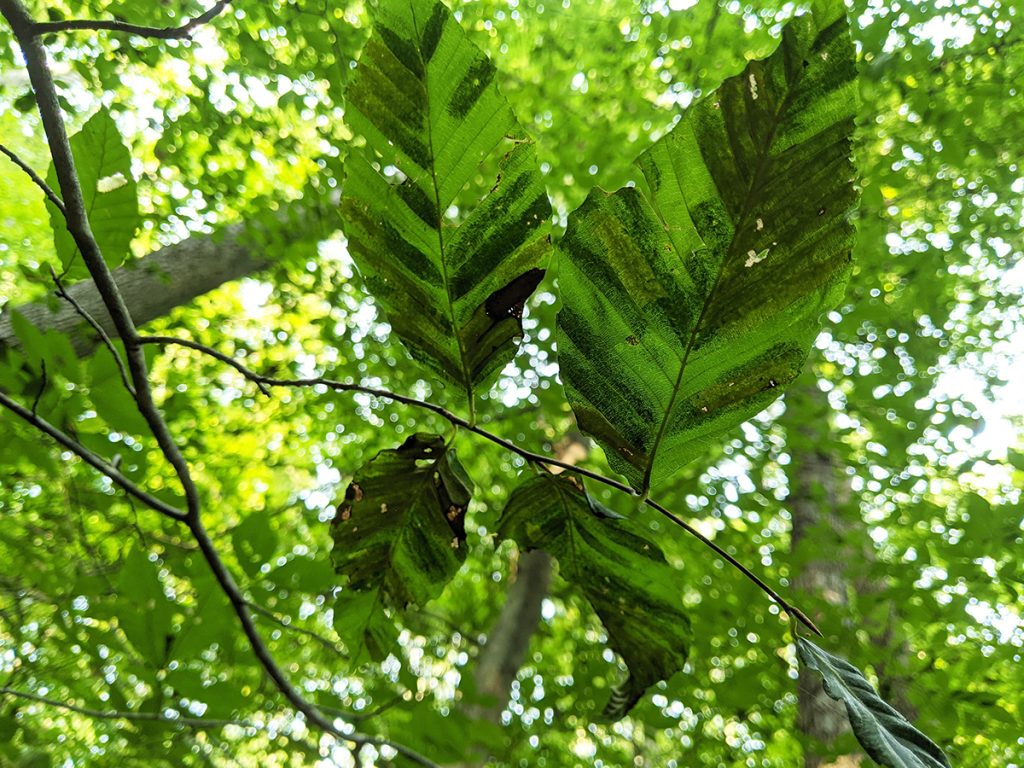
Initially, just a few diseased leaves may appear among the branches, but as the growing season moves along, things get worse. Leaves turn yellow, become leathery, curl up and drop early. Over time, the thinning canopy reduces the tree’s ability to photosynthesize—the process whereby leaves capture sunlight, water and carbon dioxide and manufacture food for the tree. The weakened tree then becomes susceptible to other pests and diseases.
Small saplings are especially vulnerable to Beech Leaf Disease and are likely to die in a year or two. Larger, mature trees can hang on longer but may die in seven to ten years as their canopies decline.
“In Northern Virginia, where we first detected the disease, we are definitely seeing impacts to older, mature trees,” said Lori Chamberlin, forest health program manager for the Virginia Department of Forestry. “Eventually it will impact all sizes and age classes of trees.”
What’s at Stake?
This disease is a threat to all types of beeches, including the European beeches planted in this country as ornamentals. More far-reaching is the risk to the American beech, one of the most common and ecologically important trees in eastern U.S. forests. In The Tree Book, authors Michael Dirr and Keith Warren describe it as one of the few native trees to exhibit “species ubiquity.” This means it can withstand climate and soil extremes found throughout its range, which reaches from Canada to Florida to Texas. Plus, in their words, this tree “oozes nobility.”
It’s also a prized resource for wildlife. Wild turkeys, bears and other animals feast on beechnuts, which are edible for humans as well. The foliage provides food for more than 100 species of caterpillars, which in turn provide food for birds and their young. Now this tough, noble and valuable tree faces an uncertain future.
What Is the Cause?
It took several years for scientists to find the cause of Beech Leaf Disease. That’s because the culprit is an oddity, a leaf-dwelling nematode, Litylenchus crenatae ssp. mccannii. Nematodes—microscopic roundworms—are all around us, but they typically live in the soil. This critter takes up residence in the tree’s leaf bud, where it lays its eggs and begins its damaging lifecycle as the leaf emerges in spring. The nematodes proliferate in the leaf through the summer and then migrate to new leaf buds, where they overwinter and continue the infestation.
“In my field of work in forest health, this is unusual. It’s the first disease I’ve dealt with that involves a nematode,” said Chamberlin. “It may be why it took a little bit of time for scientists to figure out and actually identify the causal agent.”
Although this pest is suspected to be a foreign invader, its origins are still unclear. How it spreads is also uncertain. Possible vectors of transmission include birds, caterpillars and other creatures that use the tree as habitat, as well as wind and rainwater splashing on infected leaves after they’ve fallen.
What Can Be Done?
Like the disease itself, effective treatments are still emerging. Among the most promising is injection of a product with the active ingredient thiabendazole, widely used for prevention of Dutch Elm Disease. Although this application is still experimental, Virginia is one of 24 states that have allowed it for this “special local need.” Don’t try to do it yourself. To keep you and your tree safe, engage an experienced arborist certified by the International Society of Arboriculture.
Such treatments may save a tree in a home landscape or an urban park, but they will be difficult to apply over the beech’s enormous natural range. We can do our part by keeping an eye out for the disease and preventing infested plant material, such as pruning debris, from being transported to unaffected areas. Even cleaning our boots after a hike in the woods can be helpful. Chamberlin says she keeps Lysol wipes in her vehicle just for this purpose.
Inevitably, beeches will decline in eastern forests, but there’s a potential upside. The loss of beech trees could provide openings in the canopy where much-needed oak regeneration could begin. “That’s the best-case scenario,” said Chamberlin.
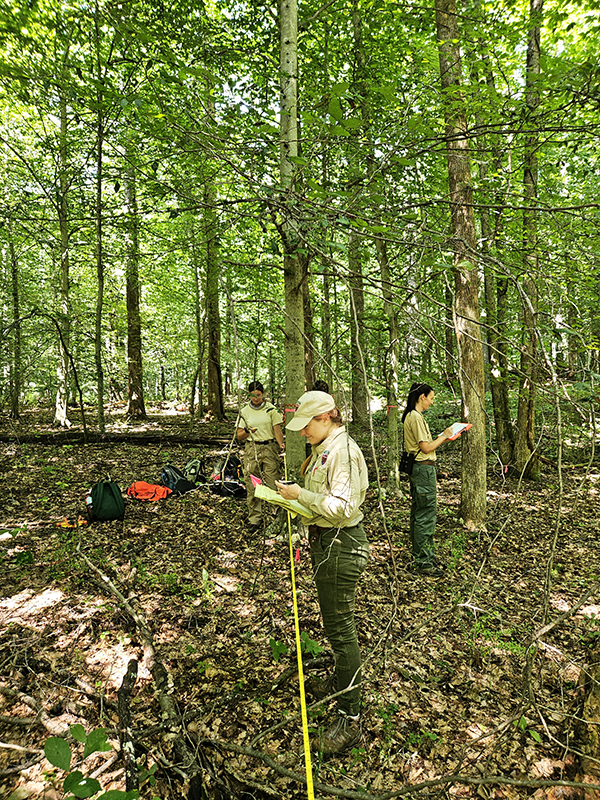
The Virginia Department of Forestry has set up monitoring plots for Beech Leaf Disease in Albemarle and four other counties around the state. Now that the disease has been confirmed here, there is no further need to report local cases. However, Chamberlin said her office would be happy to help local residents determine if a tree is infected. Don’t mail in a sample. Rather, send a photo and a description by email to foresthealth@dof.virginia.gov.
.