With the arrival of fall, summer weeds, such as crab grass, spotted spurge, carpetweed, lambs quarter, and pigweed, are already at the end of their normal life cycle or soon will be. But don’t be fooled into thinking you can relax and put away your weeding tools for the year. Now, it’s time to think about winter weeds.
WHAT’S THE DIFFERENCE BETWEEN SUMMER AND WINTER ANNUAL WEEDS?
Weeds fall into the following basic categories: annuals, biennials, and perennials. In short, annual weeds complete their life cycles in one growing season, biennial weeds require two growing seasons to complete their life cycles, and perennial weeds typically live for more than two years.
The annual weed category can be further broken down into two types: Summer (warm season) annuals and winter (cool season) annuals.
- Summer annual weeds germinate from seeds in spring or summer when soil temperatures warm up to 55°F or higher. As summer temperatures increase, these weeds grow rapidly, flower, produce seeds and then die by late summer or fall.
- Winter annual weeds germinate from seeds in autumn when air temperatures fall below 75°F for an extended period. While most stay alive over winter as small green plants, some form a basal rosette (a circular cluster of foliage located low to the ground at the base of the plant). The rosette protects the plant’s shoot apical meristem, which is responsible for generating shoots and leaves. As temperatures start to warm up in early spring, winter weeds begin actively growing. They flower, set seed and then die with the arrival of hot summer weather. Winter annual weeds may also germinate in early spring while the soil is still cool.
EXAMPLES OF WINTER ANNUAL WEEDS
The following are examples of some of the more common winter annual weeds found in the mid-Atlantic area:
Annual Bluegrass (Poa annua) is a light green, bunch-type grassy winter annual weed that is commonly found in lawns and in thin turf areas. It may also be found in moist, compacted soil, such as found in the edges along driveways and sidewalks. An individual annual bluegrass plant is capable of producing hundreds of viable seeds, even when closely mowed. The seeds may remain dormant in the soil for years before germinating. Annual bluegrass is most noticeable in early spring and easy to spot due to its light colored seedheads, which are visible even at very low mowing heights. It generally dies back when the weather becomes warmer during the summer months. This causes bare spots in lawns that should be reseeded in early fall.
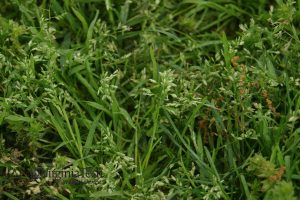
Bedstraw (Galium aparine), also commonly called catchweed or cleavers, is a gangly looking weed that can grow up to 6 feet. However, it has a weak stem and cannot stand up on its own. So, it clambers up over other vegetation or sprawls across the ground with the help of tiny hook-like hairs on its leaves and stems. Bedstraw germinates in the fall, overwinters as a tiny plant, and then rapidly grows in spring. It may also germinate in early spring. It produces tiny fruits with bristles that cling to fur and clothing. If you pull up the plant, make sure you get all the root. Otherwise, this weed will regrow from any segments left in the soil. An individual plant may produce 300 to 400 seeds, which will remain viable in the soil for only a couple of years.
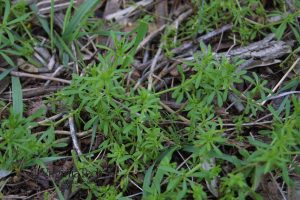
Common Chickweed (Stellaria media) forms low-spreading mats of light green foliage. It prefers cool, moist shaded soil and grows 3- to 6-inches in sun and taller in shady conditions. While it typically germinates in both fall and spring, it can also germinate throughout the growing season. It reproduces by seed and roots which form at nodes on stems that touch the ground. In spring it displays tiny star-shaped white flowers. Each plant is capable of producing up to 15,000 seeds, which can remain viable in the soil up to 10 years.
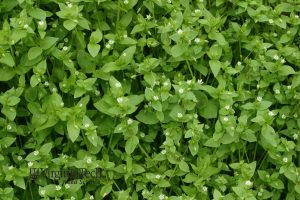
Corn Speedwell (Veronica arvensis) typically germinates in fall, but it can also germinate in early spring and even in summer if growing conditions are cool and moist. The seedlings branch at the base and quickly form dense mats. Flowering peaks in late spring and may continue into August. The plant produces heart-shaped hairy seedpods that contain 14 to 20 tiny seeds per pod. Corn speedwell is one of nine speedwell species, four of which are perennials. If you have access to Weeds of the Northeast (listed below under Sources), check out Table 16, which compares the leaves, flowers and life cycles of all nine species.
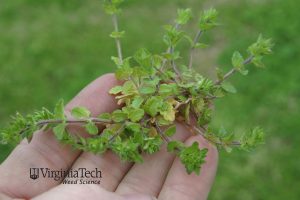
Deadnettle (Lamium purpureum) has a square stem, which is a clue that it is a member of the mint family. Deadnettle is sometimes confused with henbit (Lamium amplexicaule). Whereas henbit has scalloped leaves, deadnettle leaves are more triangular in shape and have a purplish cast. One deadnettle plant can produce 30,000 seeds. For an excellent description of the differences between henbit and deadnettle, see here.
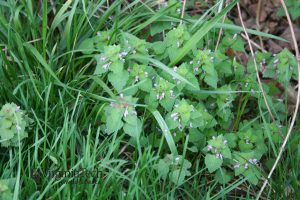
Hairy Bittercress (Cardamine hirsuta) gets its name from the tiny hairs on its leaves and stems. Although primarily a winter annual, this member of the mustard family is both a cool season and a warm season weed. Occasionally, it is biennial (germinates the first year, then blooms, sets seeds and dies the second year). It germinates in moist, cool soil and grows from a flat basal rosette, which may overwinter in mild climates. It can produce several generations of seeds in one growing season. One plant can produce 600 to 1,000 seeds. Hairy bittercress explosively ejects its mature seeds up to 10 feet away when disturbed.
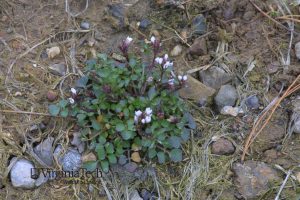
Henbit (Lamium amplexicaule), like deadnettle (Lamium purpureum), is another member of the mint family. Its leaves are scalloped on the edges and its small purple-pink blossoms occur in early spring. It can spread aggressively. In addition to producing about 200 to 2,000 or more seeds per plant, it also takes root wherever the stem nodes touch the ground. Despite its weedy habit, Henbit does have several useful attributes. It is an important early-season source of nectar and pollen for honeybees. Although dormant in summer, its sprawling nature can cover the soil and help prevent soil erosion in spring and fall.
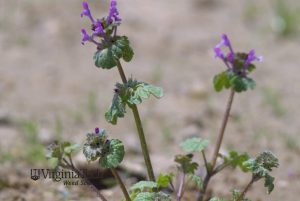
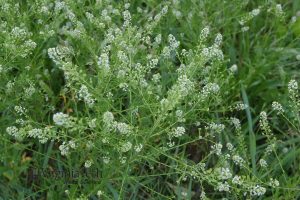
Virginia Pepperweed (Lepidium virginicum) is considered to be both a cool season and a warm season weed and may also be biennial on occasion. It has a tap root along with secondary fibrous roots. The plant overwinters as a basal rosette and then starts actively growing vertically in spring. This plant is a prolific seed producer, which makes it a nuisance in the landscape. An individual plant may produce from 500 to more than 1,500 seeds. On the other hand, bees pollinate it and it serves as a larval host for several butterfly and moth species.
CONTROLLING WINTER ANNUAL WEEDS
The most effective way to control winter annual weeds is to prevent their seeds from germinating in the first place. This can be accomplished by:
- Applying a layer of mulch over bare soil. Depending on your specific garden or landscape needs, cover the soil with a 2” to 3” layer of shredded bark, chopped leaves, straw or other organic mulch. This blocks the sunlight from the soil and can often be enough to prevent weeds from germinating.
- Planting ground cover plants in the landscape and cover crops in the vegetable garden. They serve as a “living” mulch and help outcompete weeds for resources. In addition, they benefit other nearby plants by shading the soil, which helps cool it and retain moisture.
- Positioning new plantings close enough to one another so that, as they grow to their mature size, their leaves will shade the soil and block sunlight.
For winter annual weeds that have already sprouted, the best time to control them is right after they emerge from the soil in fall for the following reasons:
- Their roots are not well developed at that point, so they are easy to remove with little disturbance to the soil.
- If you wait until the weeds are larger, hand pulling, digging or hoeing them may cause greater disturbance to the soil, which can unearth other buried weed seeds. So, it’s important to minimize soil disturbance as you remove sprouted weeds.
If faced with a challenging weedy situation that can’t be readily controlled using mechanical or organic methods, it may be necessary to apply an herbicide, but this should always be a last resort. In this situation, knowing the difference between summer annual weeds and winter annual weeds matters in determining the most effective timing and control method. For example:
- Summer annual weeds. Pre-emergent herbicide must be applied in early spring before the soil temperature warms up to 55°F. If applying a post emergent herbicide to actively growing weeds, it should be applied any time between late spring through mid-summer.
- Winter annual weeds. Pre-emergent herbicide must be applied in late summer or early fall before seeds germinate. Post emergent herbicide should be applied to growing plants in late winter and early spring.
Before applying any herbicide, make sure you choose the one best suited for your specific weed problem. A selective herbicide, for example, kills only certain plants but doesn’t harm others. This type is used in lawns to kill certain broad-leaf weeds while not harming turf grasses. A non-selective herbicide can damage or kill any plant it touches. For any herbicide you choose, it is important to study the accompanying product label for information on how and when to use the product and how to store and dispose of it safely.
For detailed information on controlling weeds in the lawn, see the Virginia Cooperative Extension’s 2026 Pest Management Guide – Home Grounds and Animals.
AND FINALLY
Understanding winter annual weeds and their unique life cycle is essential to controlling them in the lawn, landscaped areas, and vegetable gardens. To learn more about these and many other weeds typically found in the mid-Atlantic area, take advantage of the links included below to Weed ID websites for Virginia Tech, the University of Maryland, and North Carolina State University.
FEATURE PHOTO: Common Chickweed. Photo: Virginia Tech Weed Identification
SOURCES
Weeds of the Northeast (Uva, Richard H.; Neal, Joseph C.; DiTomaso, Joseph M., 1997)
2026 Pest Management Guide – Home Grounds and Animals, Virginia Cooperative Extension Publication 456-018
Two Winter Weeds on the March by Fairfax County Master Gardener Gretchen Spencer.
Weeds, North Carolina Extension Handbook, Chapter 6
Winter Annual Weeds, Missouri Botanical Garden
Weed ID, North Carolina State University Extension
Weed Identification, University of Maryland Extension Handbook
Weed Identification, Virginia Tech College of Agriculture and Life Sciences