Overview
If growing space is an issue that limits your gardening efforts, it may be worthwhile to consider “vertical gardening”. Vertical gardening uses a variety of structures to enable plants to grow vertically rather than lay or spread out on the ground. It can be a helpful technique for limited planting spaces or to utilize available space more efficiently. It can be applied to home gardens, balconies, decks, patios or any other outdoor or indoor spaces where making best use of space is desired.
The verticality can come from trellises, stakes, cages and other support structures that enable plants to grow upward rather than spread out. Vertical gardening offers several significant benefits including more efficient use of garden space and easier watering especially for vining plants where finding the root area is tricky as the vine grows. In addition it can improve air circulation to reduce disease pressure and get growth off the ground yielding cleaner crops and higher crop quality. Finally, less bending can be a helpful benefit for older or physically limited gardeners.
Edible crops that do well when grown vertically include vining plants like pole beans, snap peas, cucumbers, some melons and indeterminate tomatoes. It is possible to grow watermelons and pumpkins vertically but they require extra strong supports. Also, the fruits may need to be secured to the supports to prevent damage arising from the plant’s size and weight.
Types of Vertical Supports
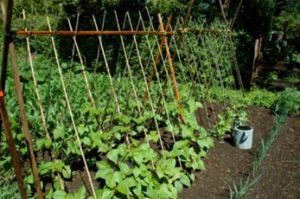
Trellises of various types are probably the most widely used supports in edible gardens. They require sturdy vertical members that are attached to horizontal lattices, offering growing plants a climbing surface. Trellises can be two dimensional, like a fence, tent shaped with double growing surfaces, teepee shaped using several wooden, rebar, metal conduit, bamboo or other pole materials that are tied together using wire or string. There are lots of trellis options available for purchase from garden centers if DIY creation is not desired.
Planning trellis position is important. Their height can block the sun from other crops. This can offer protective shade to crops sensitive to summer heat, but also undesirable shade for crops that want heat and/or direct sunlight for best growth.
Climbing surfaces can be plastic netting, wood lattice, nylon or metal fencing, or string. Considerations include keeping horizontal lattices close enough to each other to enable the plants to reach them (typically about every 4 inches) while assuring access for hands to reach through netting or fencing to harvest fruits.
Staking
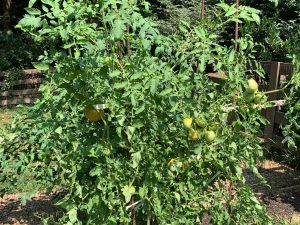
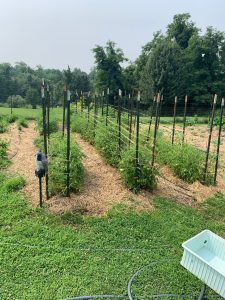
Staking uses individual posts made from the same materials noted above for trellis construction, to support plants that are prone to bend to the ground as fruits mature. Individual posts can be used to tie vertically growing plants, like indeterminate tomatoes, as they grow. Stakes can also be aligned along a plant row, one stake between every two plants (see photo below), tied to fencing or netting, to which the crops can be tied as they grow. This technique is called “stake and weave” (similar to “Florida weave” , “basket weave”, etc). It is an easy and practical way to support long crop rows. Again, tomatoes are a typical user. It is recommended to wash stakes between uses to reduce disease transmission.
Caging
Caging uses materials like wire fencing to create supports that encircle individual plants. Cages can work well with heavier crops like melons, squash, cucumbers and tomatoes. Depending on crop size, cutouts in various locations on the cage may be needed to harvest larger fruits. Individual fruits may need to be tied to the cage to prevent plant damage due to size and weight issues.
Adaptability
It is probably evident that these vertical gardening techniques are quite flexible. While conventional vegetable gardens are an obvious user in order to maximize efficient space use, it can also be adapted for potted plants, both large plants on porches and patios or shelf-like structures that support multiple smaller pots of herbs, flowers etc.
Another possible application is to utilize supports like wire fencing such as a garden or property fence. Planting crops that align with them enables them to grow by climbing rather than sprawling. Applications are many.
Other Issues
Knowing your plant characteristics is important. For example, some plants entwine or will wrap around the support structure, others will need tying to prevent them from bending back to ground.
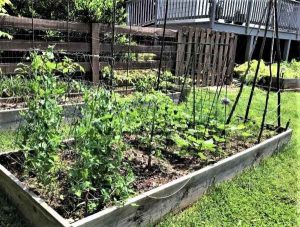
It can also be wise to integrate plant supports with a crop rotation plan. Crop rotation offers benefits including reducing pest and disease problems from year to year and can help maintain consistent soil condition. This can be difficult with permanent fencing, but is simple and practical with freestanding trellises, stakes or cages.
These issues are all solvable but do require some consideration for the most convenient and impactful results.
Conclusion
Vertical gardening is a versatile and practical way to optimize use of limited garden space. It can support many garden types from soil based to large pots for porch or patio use to shelf based growing of herbs or flowers in multiple small pots. It can increase production possibilities while improving crop health and simplifying growth and harvesting management. This article outlines possibilities and the sources listed below provide further guidance and photos that illustrate various options.
I hope that this information stimulates gardeners to improve space use, crop production and gardening enjoyment this year and in the future.
Sources:
Vertical Gardening, U of Utah Extension: https://qanr.usu.edu/smart-foodscapes/files/Vertical_Gardening_May2024.pdf
Vertical Gardening Using Trellises, Stakes and Cages, VA Tech Extension, https://www.pubs.ext.vt.edu/content/dam/pubs_ext_vt_edu/HORT/HORT-189/SPES-450.pdf
Victory Garden 101, Kansas State Extension, https://www.sedgwick.k-state.edu/local-food/victory_garden_101/vg101documents/VG101.VerticalGardeningNotesReferences.pdf
Grow more in less space with vertical gardening, Oklahoma state Extension, https://news.okstate.edu/articles/agriculture/2018/vertical_gardening.html