
Every year around this time, when the leaves start to fall, I look for green in treetops: Mistletoe! As a child, I remember December walks in the woods with my great uncle and at least one cousin looking for mistletoe. My uncle, armed with a rifle, was the best at spotting the plant and, in my memory, always brought it down with one shot.
Years later, still looking at the treetops, I pointed out some mistletoe and told my youngest what it was. He looked up and said, “we learned about it in school; it’s a parasitic plant.” So much for my excitement. But it did prompt me to learn more about the focal point of my winter drives.
Today we typically think of mistletoe as a holiday decoration but myths and traditions relating to it date back centuries. In the Middle Ages it was believed to have life-giving powers, was used for fertility and as an aphrodisiac, and was believed to protect against poisons and evil spirits. Ancient Greeks used it for many medical conditions. The tradition of hanging mistletoe at Christmas appears to have started in Victorian England and based in Norse Legend. Mistletoe is also an interesting plant.
There are hundreds of species around the world. Our mistletoe, Phoradendron leucarpum, American, eastern, or oak mistletoe, is native to central and eastern, and some portions of the western United States. This is the mistletoe of Virginia and the Carolinas, where the photos in this article were taken. The genus Phoradendron means “thief of trees” and is derived from Greek.
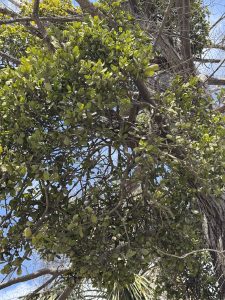
Mistletoe is an obligate hemiparasite – it requires a host in order to live and extracts water and nutrients from the host using haustoria or modified root-like structures. But mistletoe also produces its own food through photosynthesis. Although commonly found on maple and oak trees, it is not especially picky and can live on many species of deciduous trees. A host tree may weaken or die with a very dense amount of mistletoe, but this is somewhat rare.
Typically found in the forest canopy, mistletoe grows in full sun to part shade. Propagation occurs when birds eat the berries and leave droppings containing seeds on a tree branch. (The word “mistletoe” derives from Anglo-Saxon words for dung twig.) It is a slow growing evergreen which forms clumps up to three feet high and wide. Its yellow-green leaves are leathery and waxy. Small, inconspicuous flowers bloom in late fall and develop into white berries.
Although poisonous to humans, mistletoe berries are eaten by a variety of birds and some mammals, especially when other food is scarce. It is also a host species for the Great Purple Hairstreak butterfly (and other hairstreak butterflies) whose caterpillars feed solely on mistletoe leaves.
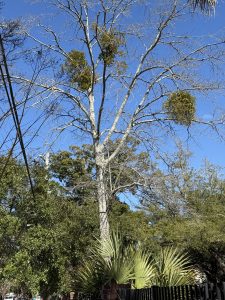
I have been looking for mistletoe for years when I drive in the winter and still get excited when I find it. There are some specific places where I know it grows, for example, in a tree in the median of I-64 near the Crozet exit. And on a drive to South Carolina in March, I was surprised to see an abundance, even on a corner in downtown Charleston.
The next time you are out when the trees are bare, look up! You may be surprised how much mistletoe you see.
All images by Denise Lunsford.
Sources:
Clemson Cooperative Extension Home & Garden Information Center, Mistletoe, https://hgic.clemson.edu/mistletoe/
North Carolina Extension Gardener Plant Toolbox, Phoradendron leucarpum, https://plants.ces.ncsu.edu/plants/phoradendron-leucarpum/
South Carolina Native Plant Society, American Mistletoe (Phoradendron leucarpum): Grand Strand December 2023 Plant of the Month, https://scnps.org/american-mistletoe-phoradendron-leucarpum-december-2023-plant-of-the-month/
Virginia Working Landscapes, American Mistletoe, https://www.vaworkinglandscapes.org/native-plant-watch/native-plant-highlights/american-mistletoe/
Wisconsin Horticulture Division of Extension, Overview of Mistletoe, https://hort.extension.wisc.edu/articles/mistletoe/