You’re probably as tired of fighting stiltgrass as I am. I’ve been pulling it out of my beds — and it does come up easily — but if you have huge swaths, try mowing or weed-whacking. Aim to get it before it sets seed, which usually starts around mid-August.
Japanese stiltgrass (Microstegium vimineum) is an annual invasive that flowers beginning in July into October. A single mature plant can produce about 1,000 seeds. The seeds ripen and drop to the ground between August and December and can remain viable in the soil for up to 7 years. Mowing and weed whacking it in August greatly reduces seed formation.
For more information on this invasive species and how to control it, see the Blue Ridge Partnership for Regional Invasive Species Management (PRISM) fact sheet on Japanese Stiltgrass and the Invasive Plant Control Calendar in the May 2022 issue of The Garden Shed. For a recent webinar on stiltgrass, check out “Simply Stiltgrass,” Blue Ridge PRISM Summer 2022 Meeting. You may also want to review the article “Dealing with Japanese Stiltgrass,” Plant NOVA Natives.
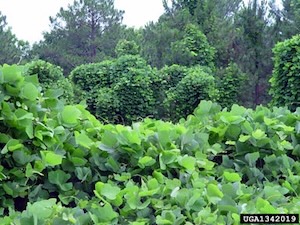
Kudzu (Pueraria montana var. lobata) — “the plant that ate the South” — may be on your agenda this month. You might spot its reddish-purple flowers, which appear in late summer to early fall. They’re kind of attractive, but this climber can wreak havoc in any yard. The Blue Ridge PRISM Factsheet suggests that foliar herbicide sprays must be applied twice a year. The first spray is applied in late spring or early summer after leaves mature. The second foliar treatment is applied in late summer or early fall.
Another option is the cut-stump method, which should also be done in late summer or early fall. Here’s how the experts at the Blue Ridge PRISM explain it:
If it is possible to cut the tangle of vines back to its crowns, instead of severing the crown from the tuber, you can apply concentrated herbicide to the cut stumps. Use a recommended herbicide at full strength. Be sure to reveal
and treat every crown. Cut stumping is best in late summer or early fall.
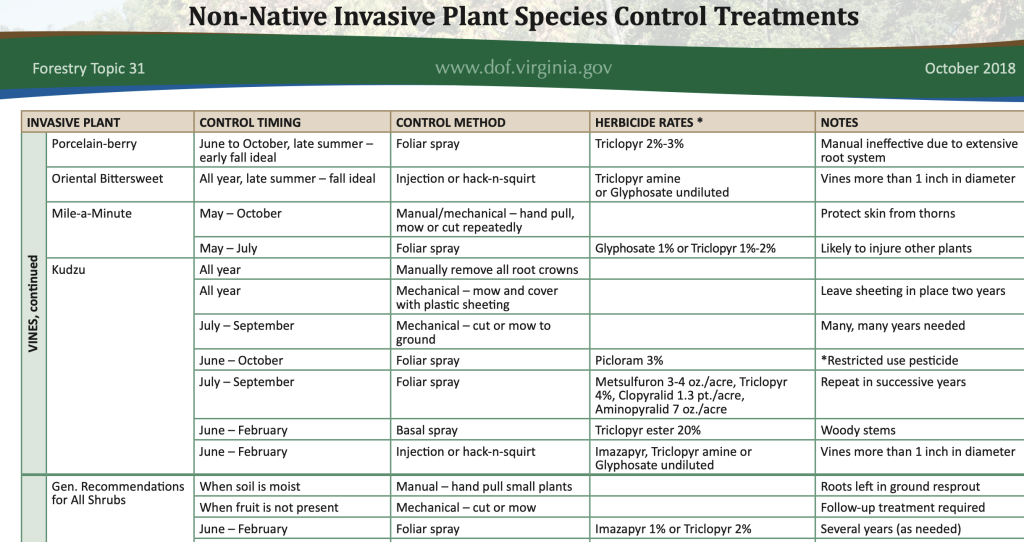
See also, Virginia Invasive Plant ID & Control Tool and use the Search function on the right hand side of the screen to find the section on kudzu — or any other invasive. The Blue Ridge PRISM recommends following the herbicide advice offered by the Virginia Department of Forestry, Non-Native Invasive Plant Species Control Treaments/Timing, Methods and Herbicide Rates A photo of that source — or at least a portion of it — appears below.
Featured Photo: Stiltgrass in yard by Sue Martin