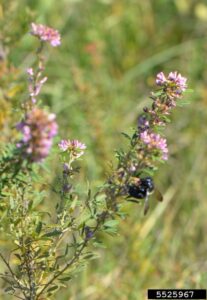
Invasive Lespedeza (Lespedeza cuneata) — sometimes referred to as “Sericea Lespedeza” — is popping up all over recently. You’re probably familiar with this invasive, but there are several species of lespedeza, including a native plant! Yes, there is apparently a native, Lespedeza virginica — commonly called slender bush clover — which has showy pinkish lavender flowers in mid-summer. See photo at right. No such attractive flowers appear on the invasive Lespedeza, which has barely noticeable and utterly forgettable tiny whitish flowers.
Invasive Lespedeza may be allelopathic, meaning that, at least according to some research, it produces chemicals that hinder the growth of other plants. According to the North Carolina State Extension, it “forms extensive monocultures and develops an extensive seed bank in the soil, ensuring its long residence at a site. Its high tannin content makes it unpalatable to livestock and most native wildlife.” NC State Ext.
How to Control Invasive Lespedeza
Mechanical Methods: Because of its deep taproot, hand-pulling lespedeza is rarely effective unless the soil is moist and the plant is young. Mowing can be somewhat effective if you’re willing to do it in a two-step process. First, you mow (or string-trim) when spring growth is about 12 inches tall. “At this stage, the root system is most vulnerable, so it rebounds weakly.” Blue Ridge PRISM Fact Sheet. But you’ll have to mow again when flowering begins on that weak rebounder or spot treat it with herbicide.
Herbicide Spray: According to the experts at Blue Ridge PRISM, “the shape of lespedeza’s stems requires a special spraying technique. Spot spray individual plants by setting the spray nozzle to a narrow stream and spraying downward above each stem from top to bottom to avoid hitting nearby desirable plants.” Blue Ridge PRISM Fact Sheet. Herbicides are effective throughout the growing season, but it’s best to do this before flowering begins.
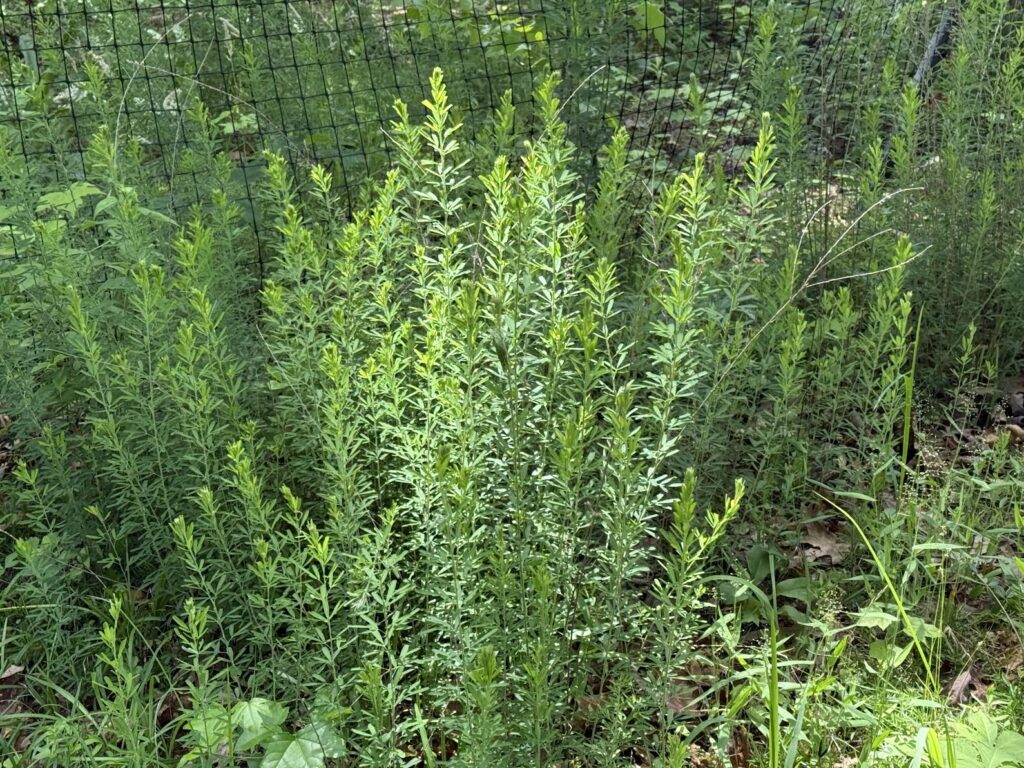
Other Invasives to Control this Month
Autumn olive can be controlled in summer by either the cut-stump method, or, if stems are large, the hack-and-squirt method. Preventing seed production is critical, so killing or cutting back autumn olive by mid-July (before seeds ripen) is essential. You’ll have to watch for re-sprouts; cut and treat new stems or apply a foliar herbicide spray to new foliage. Foliar sprays can be used from spring through fall but may need a second application. This is a very difficult plant to eradicate. See the PRISM Fact Sheet for more detail, and for guidance on these two control methods, see Blue Ridge PRISM/ Control Methods. For guidance in using the cut-stump method on autumn olive, watch this video: Controlling Autumn Olive.
Multiflora Rose (Rosa multiflora) flowers in May and June, followed by small, hard, green fruits (rosehips) in mid-summer. It is best to control this invasive before the rosehips ripen to red in fall. Several control methods are usually necessary over several years. Pulling individual plants from the soil works only if all roots are removed. You can mow or weed-whack the shrubs (using a brush cutter, not a string trimmer) and apply a foliar spray to the regrowth. You can also use the cut-stump method on the shrub with an immediate application of herbicide to the cut.
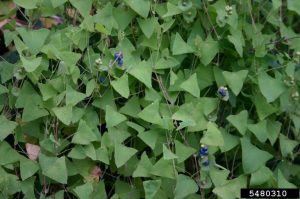
Mile-A-Minute Vine (Persicaria perfoliata, formerly Polygonum perfoliatum) begins to flower in June with clusters of tiny, white flowers, followed by green fruits that ripen to bright blue. The plant flowers and fruits continually from early summer until frost. Both manual pulling and herbicide treatments should be done before seed setting in mid- to late-June. Tiny, sharp, recurved barbs line the veins on the backs of the leaves and on the stems, which inspired its other common name of Tearthumb. Shallow roots make the plant easy to pull up, but the recurved barbs can easily pierce skin. So be sure to wear protective gardening gloves when manually pulling this vine.
Tree of Heaven (Ailanthus altissima) can be treated with the hack-and-squirt method, which is best done from June 1 to October 1. If you’d like to watch a video demonstrating how to apply the
hack-and-squirt technique, see www.youtube.com/Hack & Squirt/ Va.Coop.Ext., which is part of a longer video titled “Why, When & How to Kill Tree of Heaven.”
Featured Photo: Invasive Lespedeza by Cathy Caldwell