If we’ve had a recent rain — and wouldn’t that be wonderful? — the soil may be moist enough to hand-pull small, young sprouts of invasive plants. Be sure to remove all parts of the root so that the plant cannot regrow. Keep an eye out for the following invaders when you’re weeding your garden: English ivy (Hedera helix), climbing euonymus (Euonymus fortunei), Japanese honeysuckle (Lonicera japonica), Oriental bittersweet (Celastrus orbiculatus), Japanese barberry (Berberis thunbergia), autumn olive (Elaeagnus umbellata), wineberry (Rubus phoenicolasius), and garlic mustard (Alliaria petiolata).
Young small Japanese barberries are relatively easy to hand-pull, as I’ve only recently discovered. Just be sure your hands are well-protected from the sharp spines! You may even be able to pull a larger barberry if you use a hoe or mattock. It’s essential to remove all the roots. Surprisingly, the cut-stump method works on this invasive year-round, so it’s one avenue to try on larger shrubs at this time of year. See Penn. State Ext./Japanese Barberry.
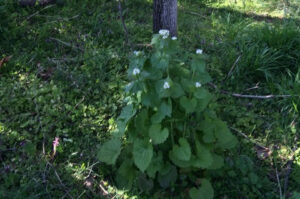
Garlic mustard invading Penn Park. Photo: Cathy Caldwell
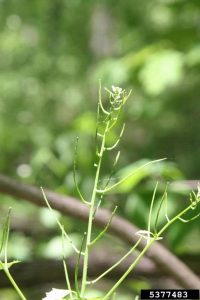
As we went to press, garlic mustard was starting to bloom. Pull it now before it sets seed. As explained by the experts at Penn. State Extension: “By early- to mid-summer (depending on flowering time), the flowers are gradually replaced by branched stems bearing the seed pods, called ‘siliques.‘ At first green, they become brown and brittle when ripe, a stage referred to as “seed shatter.” Penn.State Ext.
Aim to remove garlic mustard before it sets seed. If you pull a plant that is in flower, bag it. Do not mow garlic mustard when seed pods are present — which may be the case any time during May through September. Here’s how Penn. State Ext. explains these control principles:
Garlic mustard with siliques. Photo: Chris Evans, University of Illinois, Bugwood.org
“Garlic mustard has a taproot, and unlike some invasive herbaceous perennials, it does not regenerate from root fragments. Therefore, this is one of the few invasive plant species that can be controlled manually by pulling. Manual operations that completely remove shoot tissue will prevent regrowth. Ideally, plants should be pulled before siliques are developed, as studies have found that plants bearing siliques when pulled, even unripe ones, can still develop viable seed. For this reason, it is best practice to bag and remove pulled plants from the site, as even early pulling treatments probably include some plants that have, or will develop, viable seed.”
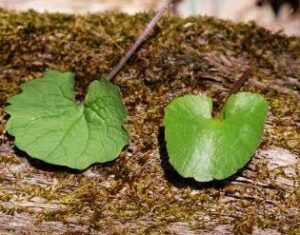
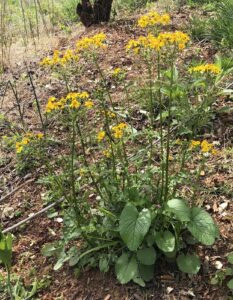
Several plants resemble garlic mustard — if you’ve got only the leaves to go by and no blooms. Two potential cases of mistaken identity are violets and our native Packera — either Packera obovata or Packera aurea. Packeraleaves are less rounded and more elongated than garlic mustard. If you’re lucky enough to have a Packera that’s planted itself in your garden — and I’ve been so blessed twice now! — you won’t want to accidentally pull it before it sends up its beautiful yellow flowers! Violets have heart-shaped leaves but are smooth and shiny, while garlic mustard’s leaves have scalloped edges and a textured surface. See the photo on the right below.
Be aware that those helpful Fact Sheets produced by Blue Ridge PRISM (Partnership for Regional Invasive Species Management) are now located in two places: some are on the PRISM website while others are located at the PRISM’s new Virginia Invasive Plant ID & Control app. The term “app” is something of a misnomer because there’s no app to download; you simply navigate to the Virginia Invasive Plant ID & Control app webpage.
Featured Photo: Garlic mustard in bloom. Photo: Richard Gardner, Bugwood.org