Guest author Linda Blum is a professor of Environmental Sciences at the University of Virginia, where she studies the effects of sea level rise on coastal soils. Classes she has recently taught include Practical Concepts in Environmental Sciences and Restoration Ecology.
Most gardeners believe the presence of earthworms in their gardens is a huge positive. That gardeners have come to think of earthworms as “good” stems from research done by Charles Darwin over 100 years ago (6). Darwin studied earthworms for nearly 40 years in his home garden. He found that earthworms don’t respond to the sound of the bassoon, but panic when exposed to middle C when played on the piano. He also estimated that earthworms move 10 tons of soil per acre per year. This article explores how earthworms affect soil properties and can be managed to increase their populations.
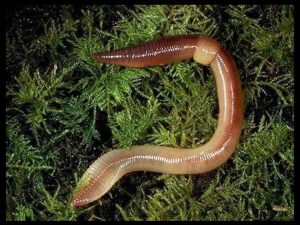
Chances are pretty good that casual conversation among gardeners about worms recalls images of the common earthworm, Lumbricus terrestris, a non-native species from Europe (Fig. 1). While there are earthworms native to non-glaciated areas of North America, including Virginia, most are non-native species from Europe and/or Asia (12), especially in agricultural and garden soils. For example, in Albemarle County, of the 15 earthworm species found, only one (Microscolex dubius) was native to Virginia (19). In Virginia, there are approximately 37 species of earthworms (19). An analysis of these species found that 17 were native and the other 20 species (54%) were non-native. This is a higher proportion of non-natives than North America considered as a whole, where 40% of the earthworm species are non-native (20). The higher proportion of non-native earthworms in Virginia likely reflects the longer time from European colonization than many other regions of North America.
Although most earthworm species in Virginia are non-native, their burrowing activity can have numerous benefits to garden and agricultural plants (7), including mixing and aerating the soil and accelerating the release of essential plant nutrients from decomposing plant material. While earthworms do great good in many gardens, croplands, and compost piles, they can cause trouble in other settings, particularly forest ecosystems (8). Earthworm activity can increase greenhouse gas emissions from soils and disrupt nutrient cycling within the soil, promoting movement of nutrients from agricultural fields to adjacent waterbodies. Even though earthworms can be disruptive in some ecosystems, the USDA Natural Resources Conservation Service considers them to be indicators of good soil quality because they have a beneficial effect on crop-plant growth (16).
Factors Affecting
Earthworms are found in many environments but not all environments. Worldwide, the main factors limiting their distribution are precipitation, availability of organic matter (food), and to a lesser extent temperature (18). Worms live where there is food, moisture, oxygen, and a favorable temperature. If soil conditions do not meet their needs, earthworms migrate to suitable habitat or they die (23).
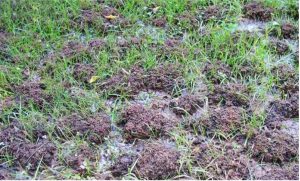
Food: Earthworms eat a range of materials. Earthworms are described as omnivorous (eating plants and animals) (21). Litter-dwelling species that consume decaying materials and bacteria and fungi associated with dead, decomposing plants and animals, earthworms are best described as detritovores when they feed on plant litter at the soil surface (11). Materials with high carbon and low nitrogen content (high C:N ratio) such as straw are not palatable to earthworms (7). Studies show that some species of earthworms preferential ingest fungi (1, 17) including those fungi which form mycorrhizal relationships with the roots of some plants (13, 10). Many other studies, including those of Darwin (6), demonstrate that some earthworms are geophagus (soil-eating); as they tunnel, they ingest large amounts of soil, digest the organic particles, and excrete material called casts (Fig. 2). Casts are a mixture of mineral and organic materials enriched in organic carbon, nitrogen, phosphorus, potassium, and calcium relative to soil (9). In some places, geophagus earthworms may bring from 4 to 8 lbs of soil to the surface in a 100 sq ft garden (16) in a year.
Water: Moist soils are essential for earthworms to thrive. Water makes up more than 75% of an earthworm’s body weight. Because worms breathe through their skin, if the worm’s skin dries out, it will die (16). Contrary to popular belief, when soils are temporarily saturated, earthworms do not come to the surface to avoid drowning (6). Earthworms can survive for several weeks underwater, providing there is sufficient oxygen in the water to support them. In fact, earthworms come to the surface during rain (or heavy irrigation) so they can move overland to new locations without dehydrating (22). Those that find themselves in puddles on sidewalks are often marooned and doomed to death by ultraviolet light. Even a few hours of exposure to ultraviolet light will kill earthworms (15).
Temperature: Worms are most active in the spring and fall when soil temperatures are between 50°F and 60°F (10°C -15°C). High or freezing soil temperatures are lethal to earthworms and will dramatical reduce worm populations. Prolonged exposure to 95°F kills worms (7). To escape high or low temperatures, some types of earthworms can move deeper in the soil. Optimal and lethal temperatures vary depending on the species; however, temperatures between 32°F and 86°F are generally compatible with earthworm survival and activity (16).
Habitat
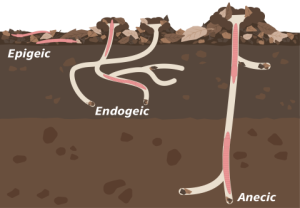
There are more than 7,000 species of earthworms (12); they are grouped into three major types; epigeic, endogeic, and anecic (2, 3, 4) (Fig. 3) based on where the earthworms burrow in the soil and the type of organic matter they consume.
The epigeic species are surface dwellers and feeders (22). They are very common in surface litter layers, compost piles, and manure where they consume large amounts of plant leaf-litter. The epigic worms are small, have bright red or reddish-brown pigmented skin, do not make burrows, do not ingest large amounts of mineral soil, or mix plant litter with mineral soil. They live for only a year.
Endogeic earthworms live in, and feed on, the soil organic matter and mineral particles near the soil surface (23). They are important because they mix surface organic matter into the mineral soil. Because they mix surface organic matter into the mineral soil (22) and selectively eat soil fungi including ectomycorrhizal fungi (10, 13, 17), they play a key role in nutrient cycling. Some of the endogeic species form shallow burrows while others create a network of horizontal, branching burrows in the mineral soil to feed and move around (22). Through their burrowing activity endogeic earthworms improve soil aeration. Endogeic earthworms are often pale colors, grey, pale pink, green or blue and tend to be a bit bigger than the epigeic worms. Endogeic worms survive for about one year (22).
Anecic earthworms make permanent vertical burrows that are 3-6 feet in depth in the mineral soil (5) . These large diameter (0.2 – 0.4 inches), deep burrows increase the water holding capacity of the soil. Anecic species feed on leaves from the soil surface that they drag into their burrows. They also deposit casts on the surface (22). Some anecic earthworm species also make middens (piles of casts) around the entrance to their burrows; the middens are often obvious especially in lawns (Fig. 2). The casts of anecic worms enhance soil structure because the cast aggregates hold together more tightly than aggregates formed solely by microorganisms (3). Anecic earthworms are darkly colored at the head end (red or brown) and have paler tails (Fig. 1). These are largest of the three major types of worms and generally live in the soil for 4-6 years, but as long as 10 years (7).
Impact on Soil Properties
A common misperception is that earthworms can improve poor-quality soil. Rather, the presence of earthworms in soil is an indicator of good quality soil (16). Soils that are low in organic matter, experience low soil moist and high soil temperatures are stressful to earthworms as well as plants. By improving soil so that it supports good plant growth, earthworms may provide additional benefits that will increase plant growth further. Some soils have inherently good characteristics that are naturally conducive to plant growth. For example, soils with stable aggregates are enriched in organic matter and increase soil porosity thereby favoring earthworm survival and activity (16) as well as plant growth. This is somewhat of a chicken-or-egg situation as earthworm burrowing increases water infiltration, water holding capacity, and development of stable soil aggregates. Regardless, soils that are rich in organic matter, have stable aggregates, and a moderate water-holding capacity tend to be high-quality earthworm habitat. Coarse textured soils are detrimental to worms because large, abrasive sand particles can damage earthworm skin and sandy soils dry out more rapidly than loamy soil, leading to earthworm desiccation (7). While it is not clear why, earthworm populations also tend to be lower in clay than in loam soils (7).
Increasing Populations
Managing soils to improve suitability for earthworm populations should focus on increasing plant residues in the soil (7, 25). To boost earthworm populations, follow the core principles of soil conservation that include minimizing soil disturbance, maximizing plant cover and diversity, and maintaining living roots in the soil year-round. Other practices that increase earthworm populations include using no- or low-till approaches, plant rotation and diverse plantings, cover crops particularly with legumes, application of organic matter (compost, mulches), managing soil pH (soil test every 2-3 yrs), and moisture content (irrigated as needed, mulch). Because no-till practices increase plant residue (food and moisture) and improve soil structure (moisture and aeration), habitat value for worms is improved. Cover crops increase food sources; planting legumes may improve food quality (lower C:N content). Adding compost and mulching increases food availability and moisture-holding capacity of the soil. Although earthworms can tolerate pH levels between 5 (or lower) and 8, managing soil pH so that it is between 6.5 and 7 promotes healthy plants which, in turn, increases earthworm abundance and activity.
One further management consideration is the use of pesticides in the garden (7). Toxicity of pesticides to earthworms depends on the type of pesticide, application rate, environmental conditions, and earthworm species and age. Generally, herbicides and fungicides are not toxic to earthworms; however, carbamate fungicides (and insecticides) are very toxic to earthworms and should be avoided if the goal is to increase earthworm populations. Insecticides vary in their impact on earthworms; some are nontoxic while others are not. As a class of compounds, pyrethroid insecticides are not toxic to earthworms. Exposure to pesticides is also a consideration. Earthworms that feed on the surface will have greater exposure than those feeding on, and burrowing below, the soil surface. Timing of pesticide application can also increase exposure. Remember that earthworms are most active in the spring and fall, when soils are moist and temperatures are moderate. Decisions about which pesticides are safe for earthworms, how much to apply, and when to apply pesticides should be based on the label included with every pesticide. Remember that the label instructions on pesticide containers are the law.
Even when the soil is ideal habitat for earthworms it can take some time to build up the population. The key to increasing earthworm populations is consistent application of the core principles of soil conservation to create a favorable environment. For example, in a study that introduced earthworms into a favorable environment previously without earthworms, earthworm abundance increased to 80 times greater than the introduced number within 4 years (7). If worms are already present in soil, some soil management practices that can have an immediate effect on earthworm abundance include adding organic amendments and keeping the soil moist (but not wet). Longer term practices that will increase earthworm abundance are minimizing tillage, increasing plant diversity, planting cover crops, and leaving crop residues on the soil surface. By adopting soil conservation practices, earthworms will come and through their activity increase soil quality by increasing water infiltration, soil aeration, plant available nutrients, and decreasing soil compaction and possibly some plant parasitic nematodes. The payoff will be improved plant growth, lush gardens and increased vegetable crop production.
References
- Bonkowski, M., B. S. Griffiths, and K. Ritz. 2000. Food preferences of earthworms for soil fungi. Pedobiologia 44(6): 666-676. https://doi.org/10.1078/S0031-4056(04)70080-3
- Bottinelli, N. and Y. Capowiez. Earthworm ecological categories are not functional groups. Biol Fertil Soils 57, 329–331 (2021). https://doi.org/10.1007/s00374-020-01517-1
- Bottinelli , N., J.L. Maeght, R.D. Pham, Valentin, C. Rumpel, Q.V. Pham, T.T. Nguyen, D.H. Lam, A.D. Nguyen, T.M. Tran, R. Zaiss , P. Jouquet. 2021. Anecic earthworms generate more topsoil than they contribute to erosion – Evidence at catchment scale in northern Vietnam. CATENA 201:105186 https://doi.org/10.1016/j.catena.2021.105186
- Bouché MB (1977) Stratégies lombriciennes. In: Lohm U. and T. Persson (eds), Soil Organisms as Components of Ecosystems, Vol 25. Ecology Bulletin, Stockholm, pp 122–132.
- Card, A. and S. Carter. 2015. Earthworms. GardenNotes #218. Colorado State University Extension. https://extension.colostate.edu/resource/earthworms/
- Darwin, C. 1881. The Formation of Vegetable Mould, Through the Action of Worms, with Observations on their Habits. London. John Murray. First edition. Digital copy download from https://darwin-online.org.uk/content/frameset?pageseq=1&itemID=F1357&viewtype=text
- Duiker, S. and R. Stehouwer. 2009. Earthworms. Pennsylvania State University. 10p. https://extension.psu.edu/earthworms.
- Frelich, L. E., B. Blossey, E.K. Cameron, A. Dávalos, N. Eisenhauer, T. Fahey, O. Ferlian, P.M. Groffman, E. Larson, S.R. Loss, J.C. Maerz, V. Nuzzo, K. Yoo, P.B. Reich. 2019. Side-swiped: ecological cascades emanating from earthworm invasions. Frontiers in Ecology and Environment 17(9):502-510. https://doi.org/10.1002/fee.2099
- Iordache, M. 2023. Chemical composition of earthworms casts as a tool in understanding the earworm contribution to ecosystem stability – a review. Plant Soil and Environment 69:247-268. https://pse.agriculturejournals.cz/pdfs/pse/2023/06/01.pdf
- Lawrence, B., M. C. Fisk, T. J. Fahey, and E. R. Suarez. 2003. Influence of non-native earthworms on mycorrhizal colonization of sugar maple (Acer saccharum Marsh). New Phytologist 157: 145–153. https://doi.org/10.1046/j.1469-8137.2003.00649.x
- Lee, K.E., 1985. Earthworms: their ecology and relationship with soils and land use. Academic Press, Orlando, FL. 411. https://archive.org/details/earthwormstheire0000leek#:~:text=*Earthworms — Ecology%2C Soil ecology%2C Land use*,* Bibliography on pages 351–388 * Indexes
- Mathieu, J., J. W. Reynolds, C. Fragoso, and E. Hadly. 2022. Global Worming: Massive Invasion of North America by Earthworms Revealed. Cold Spring Harbor Laboratory. Preprint by bioRxiv. pp. 55. https://www.researchgate.net/publication/361636082_Global_worming_massive_invasion_of_North_America_by_earthworms_revealed
- Meng, L.-L., Srivastava, A.K., Kuča, K., Wu, Q.-S., 2022. Earthworm (Pheretima guillelmi) mycorrhizal fungi (Funneliformis mosseae) association mediates rhizosphere responses in white clover. Applied Soil Ecology 172: 104371. https://ui.adsabs.harvard.edu/link_gateway/2022AppSE.17204371M/doi:10.1016/j.apsoil.2021.104371
- Misirlioğlu, M., J.W. Reynolds, M.M. Stojanović, T.B. Trakić, J.M. Sekulić, S.W. James, C. Csuzdi, T. Decaëns, E. Lapied, H.R. Phillips, E.K. Cameron, G.G. Brown. 2023. Earthworms (Clitellata, Megadrili) of the world: an updated checklist of valid species and families, with notes on their distribution. Zootaxa 5255:417-438. https://doi.org/10.11646/zootaxa.5255.1.33
- Misra, R. B., K. Lal, M . Farooq, R. K. Hans. 2005. Effect of solar UV radiation on earthworm (Metaphire posthuma). Ecotoxicology and Environmental Safety 62(3):391-396. http://doi.org/10.1016/j.ecoenv.2004.11.008
- 2022. Soil Quality Indicators. https://www.nrcs.usda.gov/sites/default/files/2022-10/Earthworms.pdf
- Pelosi, C., E. Taschen, D. Redecker, and M. Blouin. 2023. Earthworms as conveyors of mycorrhizal fungi in soils. Soil Biology and Biochemistry 189:109283. https://doi.org/10.1016/j.soilbio.2023.109283.
- Phillips, H.R. plus 142 other authors. 2019. Global distributon of earthworm diversity. Science 366(6464):480-485. https://doi.org/10.1126/science.aax4851
- Reynolds, J.W. 1994. Earthworms of Virginia (Oligochaeta: Acanthodrilidae, Komarekionidae, Lumbricidae, Megascolecidae and Sparganophilidae). Megadrilogica 5(8): 77-94.
- Reynolds, J.W. and M.J. Wetzel. 2004. Terrestrial Oligochaeta in North America north of Mexico. Megadrilogica 9(11): 71-98. https://www.researchgate.net/publication/259758338_Reynolds_JW_and_MJ_Wetzel_2004_Terrestrial_Oligochaeta_in_North_America_north_of_Mexico_Megadrilogica_911_71-98_English_abstr_English_Spanish
- Sims, R. W. and B. M. Gerard. 1985. A synopsis of the earthworms. pp 1-168, In: D.M. Kermack and R. S.G.Barnes (eds.), Keys and Notes for the Identification and Study of the Species, No. 31. Linnean Society of London and The Estuarine and Brackish-Water Sciences Association. The Pitman Press, Bath, Great Britian.
- The Earthworm Society of Britain. https://www.earthwormsoc.org.uk/earthworm-ecology.
- University of California Agriculture and Natural Resources. 2024. How Many Earthworms are Enough? https://ucanr.edu/blog/hort-coco-uc-master-gardener-program-contra-costa/article/how-many-earthworms-are-enough
- Virginia Museum of Natural History. 2021. https://www.vmnh.net/article/ben-here-with-the-friday-edition-of/3-19-2021.
- Werner, M.R. 1990. Earthworm ecology and sustaining agriculture. Center for Agroecology and Sustainable Food Systems, University of California, Santa Cruz. CA. https://sarep.ucdavis.edu/are/ecosystem/earthworm