On a Sunday afternoon in May, I followed GPS directions to Christine and Steve Platt’s house. As I drove up a hill and around the bend, I spotted my fellow master gardener in her front yard planting flowers. The bright smile on Christine’s face told me this was her happy place!
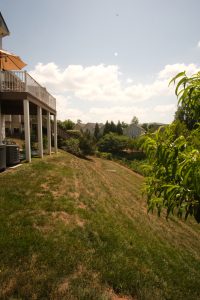
After retiring in 2017, Christine and Steve packed up and left Grand Haven, Michigan on the eastern shore of Lake Michigan, where they had lived for many years. Their plan was to traverse the country in search of a university town in a warmer locale where they could hang their hats and enjoy more leisure time. They spent a year on this quest. For those of us who live in picturesque Albemarle County, it’s no surprise that they fell in love with Charlottesville. The Platt’s enjoy being outdoors and sought a residence with ample access to nature. Both were pleased to find a comfortable, urban abode that bordered the Rivanna Trail near Moore’s Creek. The backyards of houses on their street have relatively steep elevation changes, but Christine and Steve had visions of transforming their hillside into an attractive, peaceful space. The ensuing Covid years gave them plenty of time to develop and expand on that dream.
Creating a Hillside Garden
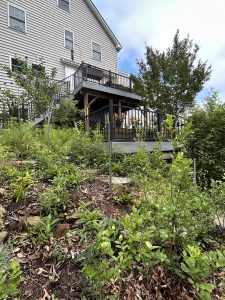
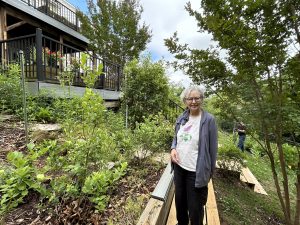
The Platts’ relatively flat front yard boasts a graceful Tilia americana linden tree with ample shade for flower beds beckoning visitors toward a friendly front porch. But our destination was out back, so Christine ushered me to the left of their abode, where huge stepping stones sloped down toward a backyard filled with a delightful variety of trees, shrubs, and native plants. Her calm, quiet manner gave me a few minutes to take in this unique setting. There, she explained the gradual process of transforming a once-unadorned grassy slope into a “serenity garden.”
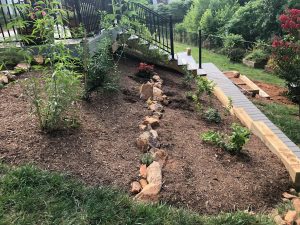
The Platts sketched out initial ideas for their backyard garden but soon discovered that determining “right plant, right place” often depends on trial-and-error. First and foremost, they needed to manage potential erosion on the steep slope. They collected large rocks to lay in horizontal strips that formed rectangular areas for ornamental plantings. Those spaces were situated between stone walkways on each side of their residence.
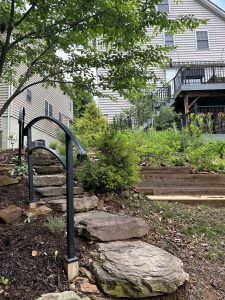
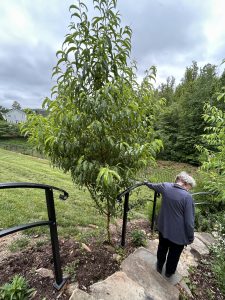
They also needed a way for humans to navigate the slope, so they developed plans for outdoor stairs. One set was a staircase of composite deck-board extending down from a patio on the bottom level of the house to the property line out back. Two other sets made of heavy stepping stones (~2-feet square and 2 inches thick) straddled both sides of their home. With safety in mind, strong, arched railings were installed along those stairways. That arrangement made it possible for people to move from house and patio through the back gardens and then return to the front yard or go inside.

While observing, I noticed several vertical steel rods in the hillside flower beds and inquired about their purpose. Christine told me those were “handholds” to prevent people from falling while doing garden maintenance on that slope. What a clever idea! Very wise of them to put safety at the forefront of landscape design.
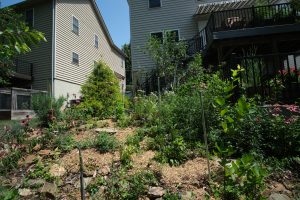
Behind the house where their property ends is an abrupt drop-off that borders natural forested areas along the Rivanna Trail. Here deer and other wildlife readily come and go. Fortunately, a 3-foot wrought iron fence had previously been installed along the back perimeter. That fence deters various critters from browsing on flowers, shrubs, and trees.
Gardening Partners
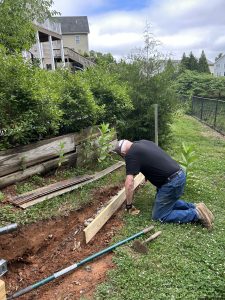
As we browsed Christine’s property, her husband Steve was hard at work installing raised beds on the lower portion of the south-facing slope. He was measuring and leveling deck-boards that would later be filled with soil. I asked what was intended for that space, and he grinned while offering his response: “Tomatoes.” I learned that the Platts would be adding new space for edibles in that sunny location. Clearly, gardening is a team effort that provides great pleasure for both of them. Christine describes her approach to gardening as “free form and naturalistic” and says that tending to plants “feeds her soul.” It’s quite apparent that Steve is an enthusiastic partner in this endeavor. Watching his fervor and skillful work with ongoing garden engineering suggests that he too embraces change and fresh ideas as they go along.
Becoming an Extension Master Gardener
Christine became a Piedmont Master Gardener in 2023, when they were partway through this extensive gardening project. Valuable new horticulture understanding brought the realization that she could have done things differently, but she’s content to build on what they started. She appreciates the deeper knowledge she gained as a master gardener, especially how to select, situate, and care for plants so they will thrive. Like most gardeners, experimentation with a variety of species and where to locate edible and ornamental vegetation is part of the process. After all, novelty is an intriguing aspect of working with living things.
Backyard Plants
In early July, photographer and master gardener intern Tyler Van Dyke joined me in a return visit to the Platt’s garden. Different flowers were blooming this time, and pollinators buzzed around us.
As we meandered through the backyard, Christine shared information about her selection of plants. Many are drought-tolerant, and they present an attractive mix of colors, shapes, and sizes when in bloom. On the sloping hillside she pointed out some of these sun-loving perennials:
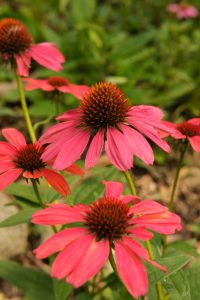
- Echinacea purpurea (purple coneflower)
- Pycnanthemum tenuifolium (narrow leaf mountain mint)
- Coreopsis tripteris (tall coreopsis)
- Chelone glabra (white turtlehead)
- Rudbeckia triloba (brown-eyed Susans)
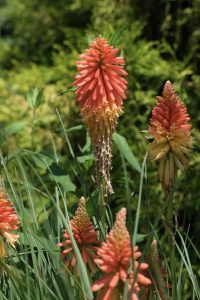
- Kniphofia uvaria (red hot poker)
- Verbena bonariensis (purpletop vervain)
- Lobelia siphilitica (blue cardinal flower)
- Rosa carolina (Carolina rose)
- Agastache foeniculum (Anise hyssop), a fragrant perennial herb
- Hypericum perforatum (St. John’s-wort), herb known historically for its medicinal uses
- Penstemon digitalis (bearded foxglove)
Trees and Shrubs
Amongst the ornamentals in the backyard are beautiful trees and shrubs of varied heights:
- Juniperus virginiana (Eastern red cedar)
- Several types of Viburnum (Mohawk, Nudum, Carlesii, Korean spice)
- Ilex verticillata (winterberry) provided height variation on the sloping terrain.
- Several apple, peach, and cherry trees that produce edible fruit
Along the Fence
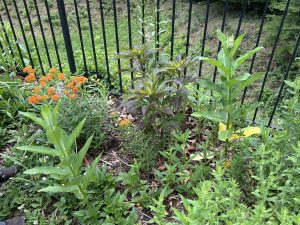
Across the back perimeter of the property another group of cheerful plants helped hide the fence in that south-facing garden:
- Hydrangea quercifolia (oakleaf hydrangea)
- Lavandula x intermedia (lavandin)
- Asclepias incarnata (swamp milkweed)
- Asclepias tuberosa (butterfly weed)
- Asclepias syriaca (common milkweed), the host plant for monarch butterflies
- Hibiscus moscheutos (swamp rose mallow) and (‘Midnight marvel’), sun-lovers in contrasting colors
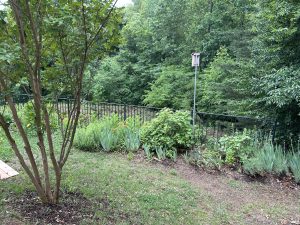
On the shaded end of that rectangular flower bed a wooded path leads to the Rivanna Trail. There, Christine had created a charming little oasis with Polygonatum (Solomon’s seals) and Matteuccia struthiopteris (Ostrich ferns).
In Christine’s list of what was planted around her home, I noticed that many of her plants were labeled as coming from another master gardener. Sharing “green babies” is definitely common behavior among us! When asked about her selections, she responded that most of her choices are based on visual appeal, or “What I like.” She also considers which plants offer nutritional value for wildlife. Indeed, during our stroll her garden was alive with pollinators sipping sweet nectar and birds swooping in and out of shrubs and trees to gather food.
Flow in the Garden
As we talked, Christine referenced the natural state of “flow” that she has experienced while engaged with planning, planting, and taking care of her gardens. Hungarian American psychologist Mihaly Csikszentmihalyi coined the term “flow” when conducting research on the creative process. He discovered that intense focus can boost happiness when an activity is appropriately balanced with an individual’s interest and skill level. Many gardeners will identify with this feeling of “flow” when they are actively immersed in outdoor horticulture endeavors. For Christine, those garden moments offer boundless joy. What a treat to witness how the Platt’s “serenity garden” gives them a meaningful sense of purpose in their retirement years.
References
Habitat gardening for wildlife
Mihaly Csikszentmihalyi | The Father of Flow
Mihaly Csikszentmihaly: pioneering psychologist
Sustainable landscaping basics
Web resources: medicinal herbs