Box tree moths (Cydalima perspectalis) are an invasive pest of boxwoods. They’re native to east Asia, spread through Europe to Canada, and were first detected in the US in 2021, in western New York state. They’ve now been found in Michigan, Ohio, Delaware, Pennsylvania, Massachusetts, West Virginia, and as of summer 2025, Virginia. In December 2025 Virginia declared a box tree moth quarantine for Winchester city and Clark and Frederick counties.
Damage
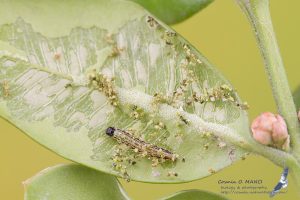
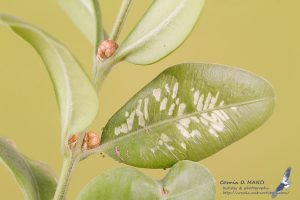
Box tree moth damage is caused by feeding caterpillars. Young caterpillars (above right) chew on the top and bottom surfaces of leaves, causing a scratched or peeled appearance (see pictures above). As the caterpillars grow, they consume more voraciously, defoliating entire plants within two weeks (see pictures below). After defoliating a plant, the caterpillars eat its bark. Needless to say, this damage is usually fatal.
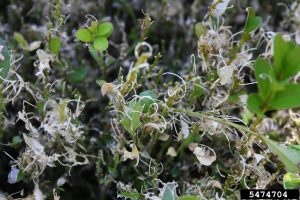
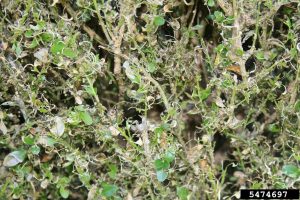
The only other major cause of boxwood defoliation is boxwood blight. An easy way to distinguish between blight and box tree moths: leaves from blight-infected boxwoods fall to the ground, whereas box tree moths consume leaves and often leave the leaves’ midribs attached to stems (see pictures above). Caterpillars also leave behind brown and black granules of fecal matter, known as frass. Other distinguishing signs of blight include black markings along stems, black and brown spots on leaves, and fuzzy white spore-forming structures.
Life cycle
Box tree moths can go through multiple generations in a single growing season. It’s not yet clear just how many generations we should expect, but according to Penn State they’re likely to achieve at least 2 rounds of reproduction in northern latitudes and 3 or more in warmer climates. In some parts of Asia they have 5 generations per year.
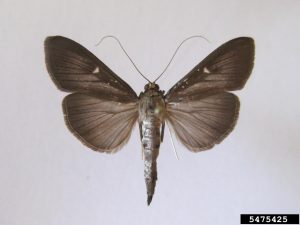
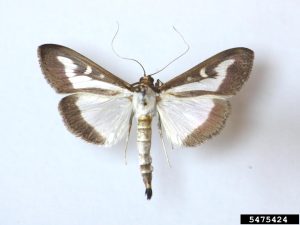
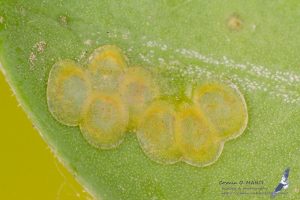
Adult box tree moths are usually white with a brown border (above left), but 5 to 10% are completely brown except for a small curved white mark near the front edge of their wings (above right). Their wingspan is 1½ to 1¾ inches. Adults can fly 4 to 6 miles during their lifetime. After mating, females lay flat, round, pale yellow eggs on boxwood leaves in overlapping clusters of 5 to 20 eggs (below left). The eggs are about 1 mm in diameter.
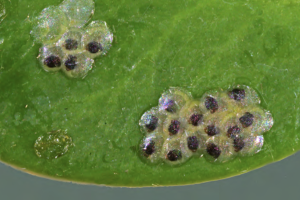
Larvae, i.e. caterpillars, hatch after about two weeks. They are green with prominent black heads – which can be seen inside the eggs (above right) – and black, yellow, and white stripes down their backs (below right). Caterpillars develop over about two weeks, growing and molting several times. At their largest, they are about an inch long. Because of the box tree moth’s capacity for multiple generations in a single season, expect caterpillars to be present in Virginia from mid-spring until mid-fall.
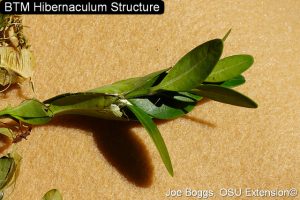
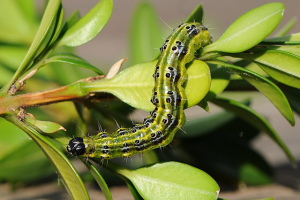
Caterpillars from the final generation of the year overwinter midway through their larval stage inside hibernacula (singular hibernaculum), protective structures formed from leaves stuck together with their silken webbing (above left). Thus protected, caterpillars can survive temperatures down to -22℉. They start developing (and feeding) again when temperatures reach about 50℉.
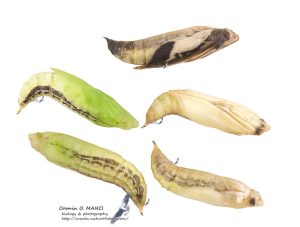
At the end of larval development, box tree moths pupate. Pupae are hidden amongst the partially eaten leaves, frass, and silk left by the caterpillars. At first pupae are light green with brown stripes (right). As they mature they become transparent, revealing the white and brown wings of the developing adult. After about two weeks of pupation, adults emerge, mate, and begin another generation.
Control
Awareness is the key to successful control of any pest. Examine your boxwoods often for box tree moths and their signs, as described above. Be sure to check underneath the leaves. Look for hibernaculae in colder months. Critically, check boxwoods before you purchase them.
Also be sure to check other potential host plants. Box tree moths have been found in its native range on burning bush (Euonymus alatus), aka winged Euonymus – itself an invasive plant (PDF) in Virginia – as well as Japanese spindletree (Euonymus japonicus), purple holly (Ilex chinensis), and orange jessamine (Murraya paniculata). It’s not yet certain that box tree moths feed on these plants in the US, but for the time being it’s best to be extra vigilant.
Physical removal is the first strategy if you find box tree moths on your plants. Pluck off caterpillars and dunk them in soapy water if you only find a few. You can also knock caterpillars off the leaves with a spray of water from a garden hose. For bigger infestations, cut off the infected branches and burn (if it’s legal in your locality), or seal in a plastic bag and throw away.
For really serious infestations, NC State has compiled a list of pesticides (PDF) that are generally effective against caterpillars. Importantly, only pesticides listed in the current Virginia Pest Management Guide may be used in Virginia. Always use skin and eye protection when applying pesticides, and follow all the directions on the product label.
A 2024 field test by Virginia Tech entomologists found that chlorantraniliprole, a Virginia-approved conventional insecticide with relatively low toxicity towards bees, was highly effective against box tree moth larvae. Promising non-conventional pesticides that can be used in Virginia include Bacillus thuringiensis var. kurstaki (sometimes abbreviated Btk) and spinosad. All of the above are contact pesticides, meaning that preventative sprays are ineffective – and in fact may be counterproductive because they can kill beneficial predatory insects.
Finally, Virginia Tech has observed that the “Winter Gem” boxwood cultivar is particularly susceptible to box tree moth damage, whereas the “Green Mountain” cultivar appears to be somewhat resistant. Keep these observations in mind when buying boxwoods, but don’t become overconfident.
Reporting
If you find a box tree moth in Virginia, use the Virginia Department of Agriculture and Consumer Services (VDACS) invasive species reporting website. You can also email VDACS to report a sighting. (If you find a box tree moth in Clark or Frederick county, or in Winchester city, there’s no need to report.) In other states, report box tree moth sightings through the state department of agriculture.
The Insect Identification Lab at Virginia Tech can help Virginia residents identify possible box tree moths. Send pictures to insectidlab@vt.edu, including the location and context (e.g. kitchen, basement, in the soil, on a plant, etc.) where you found the insect.
Concluding thoughts
The box tree moth has the potential to devastate boxwoods in Virginia and beyond, but with care and vigilance we can stop its spread. Early detection will be the key to success, so be on the lookout this spring and summer.
References and further reading
2024 updates on box tree moth (ENTO-608NP) Virginia Cooperative Extension
Alert – box tree moth (PDF) USDA Animal and Plant Health Inspection Service
Box Tree (Boxwood) Moth: New Detection, What to Look For, and Management Buckeye Yard and Garden onLine (Ohio State University)
Box tree moth Penn State Extension
Box tree moth UMass Extension Landscape, Nursery and Urban Forestry Program
Box tree moth University of Maryland Extension
Box tree moth USDA Animal and Plant Health Inspection Service
Box tree moth (ENTO-445NP) Virginia Cooperative Extension
Box tree moth Virginia Department of Agriculture and Consumer Services
Box tree moth: an invasive pest on ornamentals in nurseries and landscapes University of Georgia Extension
Box tree moth Cydalima perspectalis (PDF) University of Georgia Center for Invasive Species and Ecosystem Health
Box tree moth in the United States (ENTO-525NP) Virginia Cooperative Extension
Box tree moth: management guide Penn State Extension
Insecticide Options for Box Tree Moth Management (PDF) NC State Extension
Urgent new pest alert: box tree moth found in the US NC State Extension
VDACS announces detection of new invasive insect pest in Virginia Virginia Department of Agriculture and Consumer Services