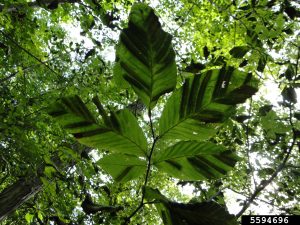
Beech leaf disease (BLD) is a rapidly spreading condition damaging beech trees in Virginia. American beeches (Fagus grandifolia) are susceptible, as are European, Japanese, and Oriental beeches (F. sylvatica, F. crenata, and F. orientalis). First detected in Ohio in 2012, BLD was found in Prince William County, Virginia in 2021. As of early 2026, it has been detected in several counties in northern and central Virginia, including Albemarle County. BLD has also spread throughout Ontario and the northeastern US.
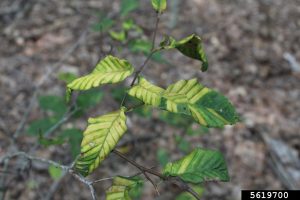
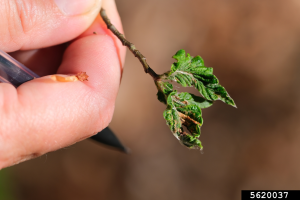
The first symptom of BLD is a darkening of leaves in bands between the veins (see photos to right). Next, the leaves cup and curl as the darkened leaf tissue thickens and becomes leathery. The affected leaves drop early. This is particularly notable since beeches normally hold their leaves all winter, a phenomenon termed marcescence. In subsequent years, leaf buds and eventually branches die, followed, more or less inevitably, by the death of the tree.
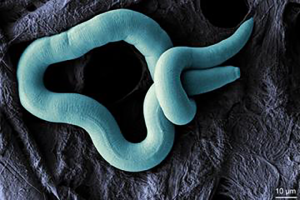
BLD is caused by a nematode, a microscopic worm with the scientific name Litylenchus crenatae, subspecies mccannii (see image below). L. crenatae infests beeches’ leaf buds in late summer and fall, then moves onto new leaves as they emerge in the spring. After feeding and reproducing on leaves all summer – causing the leaf damage described above – the nematodes move back to leaf buds to spend the winter. Severe infestations kill the buds before bud break in spring, whereas minor infestations result in damaged leaves. Minor infestations turn into severe infestations as the number of nematodes increases over the course of a few years.
It’s not yet clear how L. crenatae moves from tree to tree. It – or its eggs – may hitch a ride on birds or insects, or it might be carried by wind or rain. Regardless, it seems to move readily, having covered many hundreds of miles in a few years.
What can we do to combat BLD?
BLD is likely to cause extensive damage to beech trees throughout the eastern US. Beeches don’t have much economic value, though beechwood is famously used in beer-making. However, beeches play a central ecological role in mature forests. Its nuts are an important food source for birds and mammals ranging from grouse and turkeys to mice, raccoons, and bears. Mature beeches can be very large, contributing substantially to the forest canopy and to leaf litter on the forest floor. Beeches are particularly important in northern latitudes, where oaks are less common.
The first step in combating BLD is awareness. Note early symptoms of BLD and the location of the affected tree, then inform your local state forester. To be quite honest, there isn’t much to be done to treat or prevent the spread of BLD in forests: there are too many trees out there, and many of them are too remote to be actively cared for. Nevertheless, tracking BLD will be useful for research and planning.
The situation in cultivated landscapes is a little more hopeful. A couple of recent studies have identified pesticides that may prevent severe damage from BLD. Ask a certified arborist about potential treatments for your beech trees.
Cultural practices
Promoting overall tree health may help beeches survive a mild case of BLD.
Mature trees don’t need much care, but they do benefit from mulching. Young trees should also be mulched, of course. Mulch breaks down and adds organic matter to the soil, preventing compaction and improving water retention. Don’t mulch too deeply; any thicker than 3 inches and it won’t decay properly. Avoid the dreaded mulch volcano at all costs!
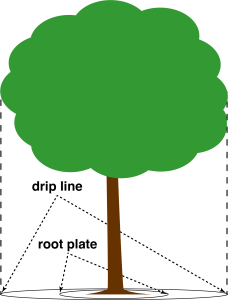
Ideally, mulch should extend all the way to the drip line, the outer extent of the tree’s canopy. At a minimum, mulch should cover the root plate, the area around the trunk with the biggest structural roots; this area extends away from the tree 3 to 6 times the trunk diameter. Keep the mulch about 3-6″ away from the trunk to avoid damaging the bark.
Pruning is particularly important for small trees so they grow into a healthy and aesthetically pleasing form. The Charlottesville Area Tree Stewards have a detailed presentation (PDF) on pruning young landscape trees. Also prune to remove dead and diseased branches before they become a problem.
Irrigate young trees during dry spells in the first 2 or 3 years after planting. A young tree needs about one inch of water per week, whether from rain or irrigation. This works out to one 5-gallon bucket in a 3-foot diameter circle. Irrigate the entire area under the drip line. Older trees don’t usually need irrigation, but in long droughts it might be necessary.
Concluding thoughts
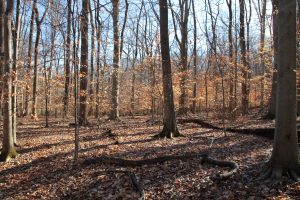
Beech trees are critical to both natural and cultivated landscapes. I touched briefly on their contributions to ecosystems above, but they also have immense aesthetic value. Their gray, smooth bark provides a beautiful contrast to darker, rougher-barked trees. Their golden-brown leaves, held on the branch until spring, soften the bare landscape in winter. Beech leaf disease is putting this beauty at risk. For beech trees in your yard, consult an arborist about strategies for keeping them healthy, if possible. And if your town has beech trees in its public spaces, encourage your local authorities to do the same.
References and further reading
Beech leaf disease Penn State Extension
Beech leaf disease UMass Extension
Beech leaf disease and management options Rutgers University/New Jersey Agricultural Experiment Station
Beech leaf disease in Maryland University of Maryland Extension
Exploring Novel Management Methods for Beech Leaf Disease, an Emerging Threat to Forests and Landscapes Andrew L. Lloyd et al. (2024)
Looking for American beech University of New Hampshire Extension
Thiabendazole as a Therapeutic Root Flare Injection for Beech Leaf Disease Management Andrew L. Loyd et al. (2025)
What is beech leaf disease? Virginia Cooperative Extension
What to know about beech leaf disease University of New Hampshire Extension