
With the arrival of November, all signs point to the end of the growing season and the beginning of winter dormancy in the ornamental garden. On warmer days, bees, flies, beetles, and other insects continue to visit the few remaining flowers in search of sustenance. Take advantage of those milder days to finish preparing the garden for cold weather ahead.
IS IT TOO LATE TO PLANT TREES AND SHRUBS?
Perennials should be planted at least 6 to 8 weeks before the ground freezes so that they have time to develop good strong root systems before the onset of cold weather. Other plants, such as the following, may be planted right up until the ground freezes:
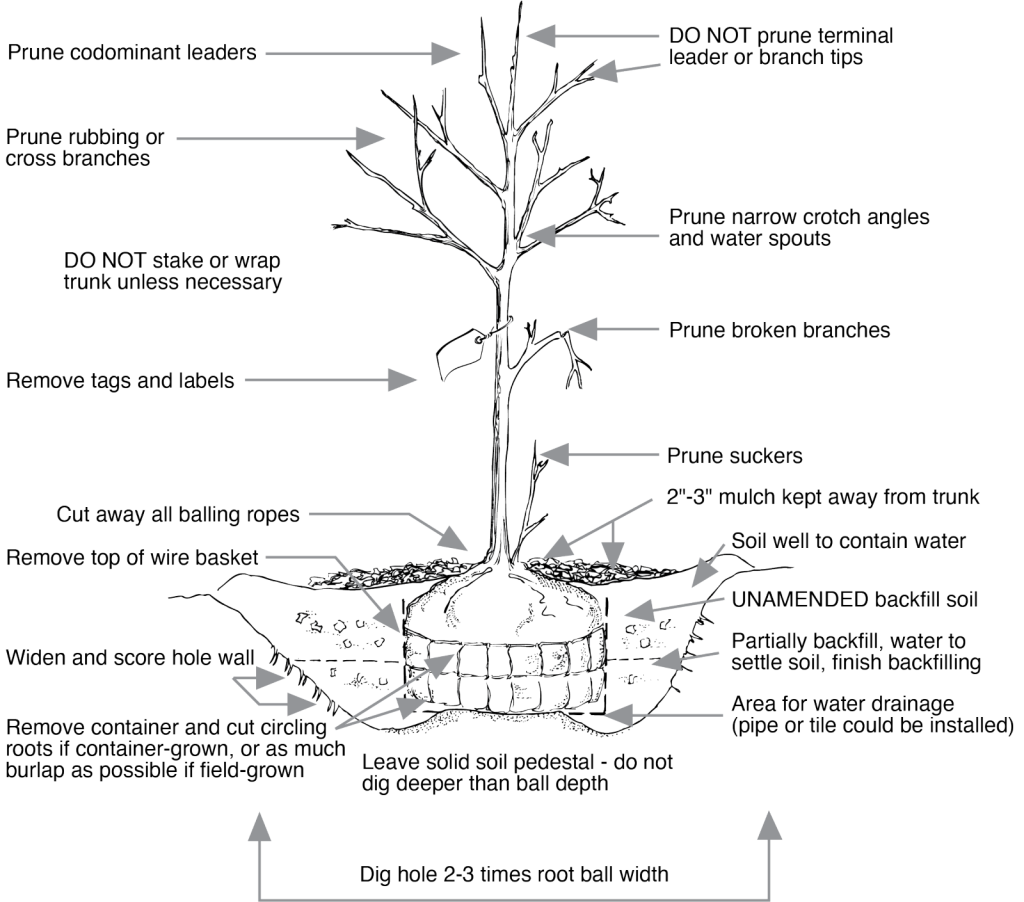
- Continue planting deciduous trees and shrubs until the ground freezes. As the weather turns chilly and you dread working outside, it may be tempting to cut corners on installing new trees and shrubs. Most failed plantings occur because the tree or shrub was planted too deeply or the root ball was not properly watered. Ideally, the hole should be no deeper than the depth of the root ball, although the depth of the root ball alone does not always determine correct planting depth. Container grown or nursery grown trees may already have excess soil covering the root flare. Once the plant is placed in the hole, the top of the roots or root ball should be level or slightly above level with the surface of the ground. Until the ground freezes, the root ball and surrounding soil should be watered slowly and deeply to keep it from drying out. For additional advice, see the Virginia Cooperative Extension’s Tree and Shrub Planting Guidelines and Planting Trees.
- If recent droughts, excessive heat, and deer browse have you wondering just what kind of tree to plant, you’ll find a very helpful chart at this publication from Virginia Tech. Although its title suggests it is solely concerned with choosing trees to avoid problems with overhead utility lines, the chart at the end of the article provides much broader guidance, including drought tolerance and deer resistance ratings. For more about trees and shrubs that are resistant to heat and drought, check out Trees that can Handle Heat and Drought/The Garden Shed, Trees that can Handle Heat and Drought: An Update, and Drought Resistant Shrubs. For help in identifying trees and shrubs that are resistant to deer, consult Landscape Plants Rated by Deer Resistance (Rutgers Ext.) and Deer, Deer, Deer!/The Garden Shed.
- Plant tulip bulbs in a prepared sunny, well-drained site once the soil cools to about 55°F and night-time temperatures range between 40° and 50°. Tulips require cool soil so that they don’t send up shoots before the roots are established. They may be planted up until the soil freezes. Plant them deeply (about three times the diameter of the bulb) to help protect them from frost heaving as well as from mice, voles and squirrels. Cover the planted area with a layer of mulch about three inches deep. TIP: If you have a deer problem, make a note to protect your tulips from deer browsing once the foliage starts to emerge next spring. Either use a physical barrier or a deer repellent.
THERE’S STILL TIME TO WRAP UP THESE TASKS BEFORE WINTER
If you’re a procrastinator or just a very busy person, you may still be working on putting your garden to bed for the winter. Here’s a suggested list of tasks to tackle before winter:
- Dig up and store tender bulbs that you didn’t get around to digging up in October. University of Maryland Publication HG105 on Overwintering Tropical Plants provides good advice on how to store caladium and elephant ear (Colocasia spp.) bulbs. It also provides guidance on how to overwinter tropical plants in general.
- Finish preparing ponds and water features for winter. Use a pond net to scoop fallen leaves from the water. Prune dead stems and leaves from aquatic plants to prevent the debris from decaying in the water over the winter.
- Drain garden hoses before the onset of cold weather to help prolong the life of the hoses. Wipe off dirt and other debris, roll up the hoses, and store them in a shed, garage, basement or other protected place out of the weather.
- Remove, clean, dry, and store garden stakes, portable trellises, and all breakable items, including terra cotta pots, rain gauges, bird baths and garden art, that might be damaged by winter weather.
- Inspect all containers of pesticides, fungicides, and herbicides to make sure they are well sealed and in their original container. Refer to the label for recommended storage conditions.
- Inspect lawn mowers, tillers, or other gardening equipment for any needed servicing and plan to have the service completed now or over the winter months.
- If you have a greenhouse, now is the time to do some basic clean up and maintenance. Clean the windows thoroughly so that the maximum amount of sunlight can penetrate to your plants. Replace any broken or cracked windows. Check all opening panels to make sure they are in good working order. Grease the hinges if needed. If you rely on a heater to keep temperatures above freezing, make sure it is in working order.
- Inspect garden tools before storing them for the winter. Remove dirt and grime from metal surfaces to prevent the formation of rust. Sharpen any tools that have grown dull from use. Finally, organize tools so that they can be easily found next spring. For detailed guidance on maintaining your tools, see the recent Garden Shed article, Prepare Your Tools for Fall Gardening.
- Cut back the stems and foliage of established chrysanthemums about three inches above the ground now or, if you prefer, wait until late winter or early spring to cut them back. If the chrysanthemums were planted this fall, they may survive cold weather better if the stems are left in place. The dead foliage will help protect the plant crown during winter. Also make sure the mums are well watered going into winter.
- Leave tall sedum standing over the winter months. The dried brownish-looking seed heads add plenty of color and texture to the garden in fall and winter. They’re also stunning when covered in frost or ice.
- Manage fallen leaves on turf and in flower beds. A thick layer of leaves on turf can block sunlight from reaching grass. They can also trap and hold moisture beneath them, which can set the stage for turf disease. But that doesn’t mean you must rake them off. Use your lawn mower to shred leaves so that the smaller bits and pieces can more quickly decompose and nourish the soil without harming the turf. “‘Leaf’ your lawn unraked this fall, turfgrass expert says,” Another option is to turn the leaves into mulch for your garden beds. To learn more about turning your leaves into mulch, see VCE publication 430-521, “Leave Them Alone – Lawn Leaf Management.” An alternative to mulching the leaves is to collect them and add them to a compost pile. See VCE publication 426-703, “Making Compost from Yard Waste,” for more information on composting. As a third option, consider leaving fallen leaves in place in landscaped areas such as under shrubs or trees where they can decompose slowly without harming the plants. The reason for doing this is to help protect the eggs or larvae of butterflies, moths, and other beneficial insects until they can emerge in spring.
- Don’t get overly aggressive about cleaning up your spent ornamentals. A little mess is actually not a bad thing. For example, plants with seed heads are a critical source of food for foraging birds over winter. Seeds from cone flower, aster species, black-eyed Susan, sedum, Joe Pye weed, coreopsis, globe thistle, and even zinnias and marigolds will be welcomed by a variety of bird species. Just focus on cleaning up stems and leaves from plants such as peonies and garden phlox, which are subject to fungal diseases, or irises, which are subject to borer infestations.
- Collect soil samples to test for pH and nutritional levels. Don’t guess what your soil needs. If the soil test indicates your soil pH needs to be raised or lowered, now is a good time to apply either lime or sulfur as needed. For more information, see VCE Publication 452-129, “Soil Sampling for Residential Areas.” To obtain a free soil testing kit, head on over to the Albemarle/Charlottesville Extension Office, Free Soil Test Sample Kits.
- If a soil test or signs of plant stress indicate the need for fertilizer, you can fertilize dormant trees and shrubs with a slow-release fertilizer so that nutrients will be available to the plants in early spring. See VCE publication 430-018, “Fertilizing Landscape Trees and Shrubs,” for information on fertilization basics, such as the signs of plant stress and diminished vigor, types of fertilizers, when to apply fertilizer, and how much. When you apply fertilizer, water it into the soil. Otherwise, the plants cannot absorb the nutrients.
DON’T FORGET TO PROTECT YOUR PLANTINGS FROM WILDLIFE DAMAGE
The garden may be going dormant now but that doesn’t mean you can stop monitoring it for signs of wildlife damage.
-

Acer griseum (Paperbark maple) with deer protection. Photo: Gail and Hal Clark Protect young trees from deer damage, which can result from male deer rubbing and scraping their antlers against tree trunks to remove the “velvet” that has been growing all summer. Rubbing is also the way a deer marks its territory and intimidates other male deer. Protect the tree trunk and lower stems with a physical barrier such as a fence, a wire mesh trunk guard, or a plastic tube or pipe. Another strategy is to loosely wrap chicken wire around the trunk. Regardless of the method used, make sure the barrier does not rub against the bark or restrict the trunk from expanding as it grows.
- Protect dormant trees from mouse and vole damage over the winter months. Contrary to what some people think, these diminutive creatures don’t hibernate. In fact, they can do some of their worst damage over the winter months. Voles, for example, can do extensive damage to the roots and bark of many woody plants. Several strategies can help mitigate the damage they cause. Install a physical barrier of hardware cloth or wire mesh trunk guards at the base of vulnerable young trees. Wait until after the first hard frost to apply mulch at the base of trees and shrubs but not touching the trunks.
HOUSEPLANT CARE
Now that houseplants are fully acclimated to the indoors after their vacation outside this summer, focus on keeping them healthy and happy within your home’s warmer, drier conditions. To learn more about the general care and feeding of houseplants, see VCE Publication 426-100, “Indoor Plant Culture.”
- Reduce or hold off on fertilizing houseplants until spring. Fertilizer requirements vary from plant to plant depending on their growth rate and the type of fertilizer being applied. In general, they require little or no fertilizer after they have been brought indoors for the winter because this is their time to rest.
- Monitor moisture and humidity levels. Moisture requirements vary by species, potting medium, light, temperature, and growing conditions. Different houseplants require different degrees of drying between watering events. See Indoor Plant Culture/Va.Tech Pub. 426-100. The biggest mistake many people make with houseplants is overwatering them. Meanwhile, most houseplants prefer relative humidity levels of about 40% to 50%. Properly Watering Container Houseplants/ VA Tech/Publication SPES 804P suggests that increasing humidity in the air can be accomplished by using a humidifier near the plants; using pebble trays with water under the plant containers, which adds moisture to the air through evaporation; and grouping plants closer together. This can help create a microclimate of moisture near their canopy and reduce transpiration too.
- Make sure light levels are adequate for the needs of each houseplant. Give each plant a quarter turn weekly to prevent the plant from leaning toward the light.
- Provide plenty of bright light to overwintered tropical plants such as mandevilla, fuchsia, or hibiscus to encourage blooms indoors. Water the plant when the top inch or two of soil becomes dry and mist the foliage periodically to raise the humidity level. If the plant is too large to overwinter indoors, it may be maintained in a semi-dormant state in a frost-free garage or basement. If you choose this storage method, water the plant sparingly so that the root ball does not dry out.
- Pot hardy spring bulbs for indoor forcing. For advice on how to force bulbs into bloom, see VCE Publication HORT-76, “Fooling Mother Nature: Forcing Flower Bulbs for Indoor Bloom.”
- Start forcing paper white narcissus bulbs now in order to have them in bloom over the winter holidays. Paper whites don’t require any period of chilling and are very easy to force. Once planted, they will bloom in about 5 to 6 weeks, according to VCE Publication HORT-76, on forcing flower bulbs for indoor bloom. This publication provides excellent graphics and clear instructions on forcing bulbs. It also provides a useful listing of bulbs commonly forced into bloom and projections on the number of weeks they should be planted in advance of flowering. Caution: Paper white narcissus is poisonous, so keep children and pets away from the bulbs and the plants. See Holiday Plants & Pets/Penn.St.Ext.
- Start Amaryllis bulbs now for a spectacular in-door floral show over the winter months. One of the easiest and most satisfying of bulbs to force, these popular bulbs, like paper whites, don’t need to be chilled in advance of forcing. They prefer to be planted in a pot that is only slightly larger than the bulb. So, select a pot that allows no more than one inch of space on each side of the bulb. If the pot is too big, the bulb may not bloom. Position the bulb so that the top third is above the soil line. Place the potted bulb on a sunny windowsill in a cool room (about 60 to 75° F). Water after potting. Afterwards, water only when the soil feels dry to the touch. Caution: Members of the Hippeastrum genus — including amaryllis — are poisonous to humans, cats, dogs, and horses, according to North Carolina State Extension. See also Holiday Plants & Pets.
Featured Photo: Cathy Caldwell