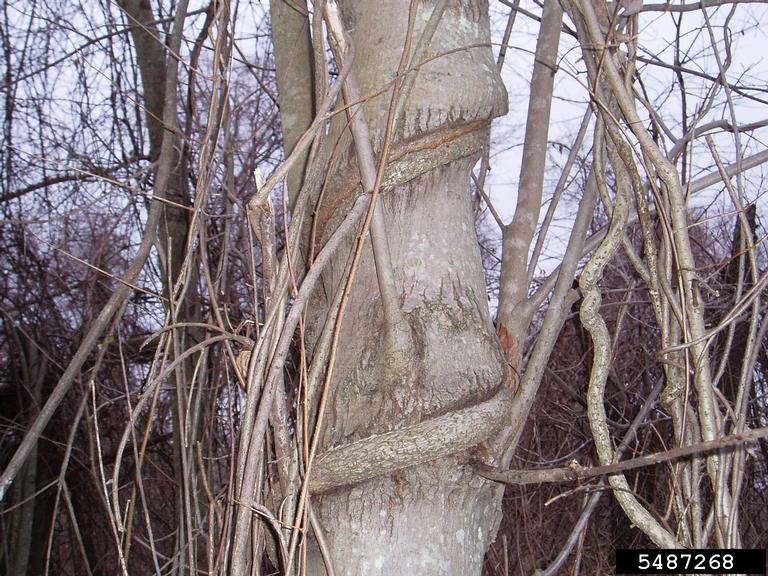
Due to its bright red and yellow fruits, Asiatic bittersweet (Celastrus orbiculatus) is easy to spot in the autumn, and this is a good time to eradicate it. This vine is now referred to by some scientists as “round leaf bittersweet”. If you’d like to watch a video about this invasive, check below.
Here are the control methods for Asiatic bittersweet suggested by Blue Ridge PRISM (Partnership for Regional Invasive Species Management):
“Manual & Mechanical: You can hand-pull small vines when the soil is moist, but be sure to remove the crown and all large roots, or vigorous new growth will occur. To avoid hurting tree branches and yourself, do not pull heavy vines from trees.
Cut Stump: Cut small to large vines near ground level,
using a hand-saw, loppers, hand clippers or chainsaw from
June through February (late summer and fall is ideal). To
prevent resprouting, immediately apply a concentrated herbicide to the cut stump or apply a foliar spray to the regrowth.Foliar Spray: Low bushy vines or resprouted vines can be
killed with a foliar herbicide spray from late spring (after full
leafout) through fall. (It is best not to spray large vines, but to
cut stump them.) To avoid harming desirable plants, apply
foliar spray when other plants have fall color or are leafless in
autumn, but while bittersweet leaves are still green.”
For more information, see Fact Sheet: Asiatic Bittersweet/Blue Ridge PRISM, Virginia Invasive Plant ID & Control Tool/Asiatic Bittersweet and Invasive Plant Control Calendar, May 2022 issue of The Garden Shed.
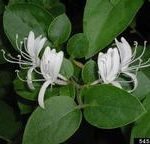
Japanese Honeysuckle (Lonicera japonica) is a rapidly spreading nonnative vine that competes for both above- and below-ground resources, inhibiting the growth of desirable trees, shrubs, grasses, and wildflowers. A woody perennial vine, Japanese honeysuckle retains its leaves well into winter (year-round in mild climates). Hand pulling young vines is effective only if all roots are removed. Any roots left in the soil will resprout. A foliar spray may be a more effective way to kill the entire plant. The best time to spray is autumn and early winter after most native plants have lost their leaves or are dormant, but before a hard freeze (25°F). Foliar sprays are less effective in spring because the herbicide does not thoroughly move from the leaves into the roots during spring growth.
For additional information on methods for eradicating Japanese Honeysuckle, refer to the Fact Sheet/Japanese Honeysuckle published by the Blue Ridge Partnership for Regional Invasive Species Management (PRISM). Also see the Invasive Plant Control Calendar in the May 2022 issue of The Garden Shed.
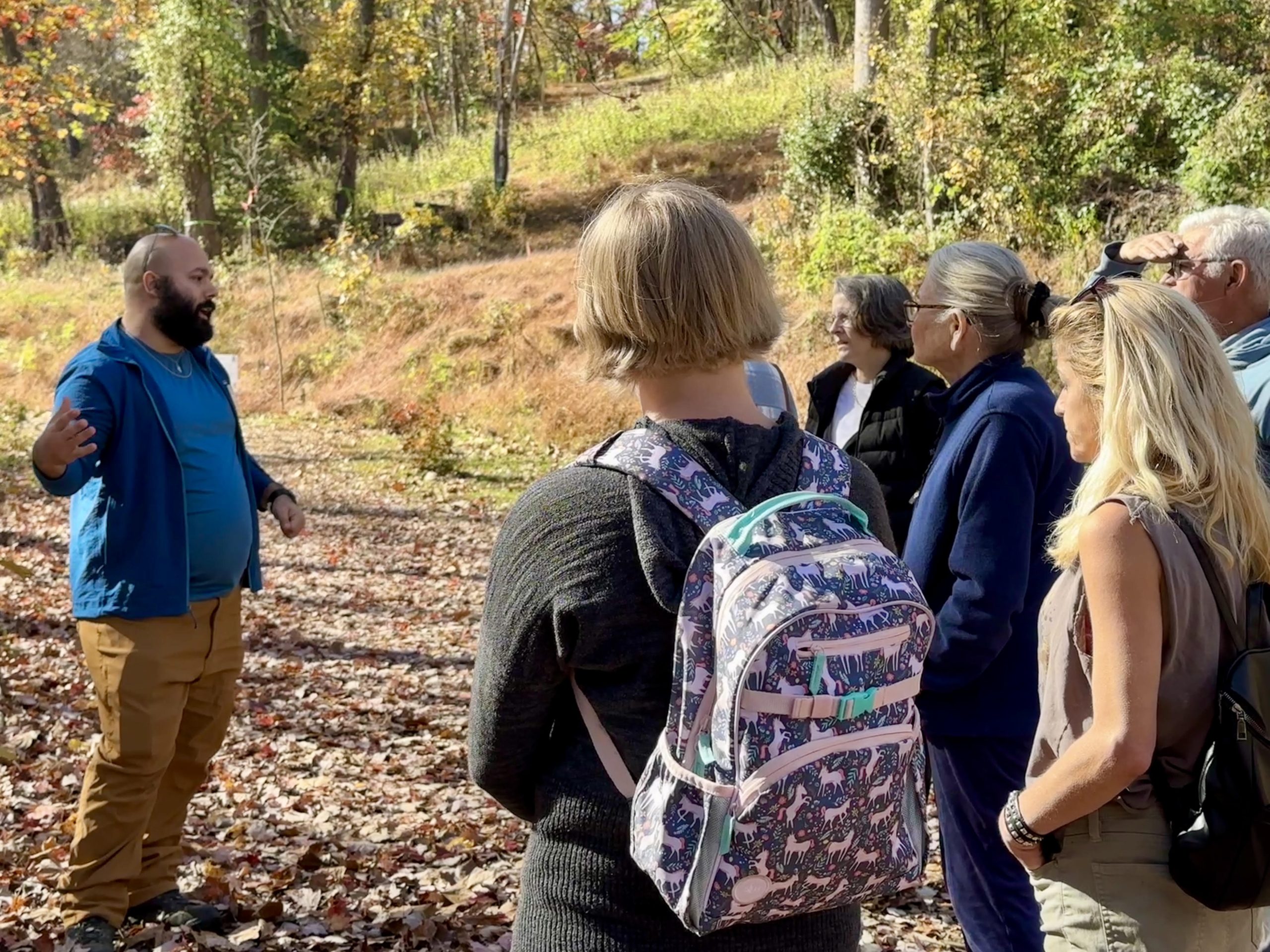
⇒To learn more about invasive plants and to join others in eradication efforts, check out these Upcoming Events sponsored by Blue Ridge PRISM:
Invasive Plant ID Walk: Hoover Ridge Park, Madison
Join Jacob Edel, Invasive Management Specialist at Blue Ridge PRISM, at Hoover Ridge Park in Madison for this FREE field training where you’ll learn how to identify invasive plants in the spring.
Conservation Stewards Workday: Ridgeview Park, Waynesboro
Learn to identify and remove invasive plants that threaten the health & enjoyment of this beautiful natural area. Space is limited to 10 participants.
Conservation Stewards Workday: Carrier Arboretum, Harrisonburg
Join Blue Ridge PRISM as we tackle invasive plants at the Edith J. Carrier Arboretum in Harrisonburg. Learn to identify and remove invasive plants that threaten the health & enjoyment of this beautiful natural area. Space is limited to 10 participants.
Conservation Stewards Workday: Blue Ridge Railway Trail, Piney River
Join Blue Ridge PRISM as we tackle invasive plants at the Piney River Trailhead of the Blue Ridge Railway in Nelson County. Learn to identify and remove invasive plants that threaten the health & enjoyment of this beautiful natural area. Space is limited to 10 participants.
PESTICIDE WARNING
Pesticides (which include herbicides, insecticides, rodenticides, etc.) are poisonous. Always read and carefully follow all precautions and safety recommendations given on the container label. Store all chemicals in the original labeled containers in a locked cabinet or shed, away from food or feeds, and out of the reach of children, unauthorized persons, pets, and livestock. Consult the pesticide label to determine active ingredients, signal words, and proper protective equipment. Pesticides applied in your home and landscape can move and contaminate creeks, lakes, and rivers. Confine chemicals to the property being treated and never allow them to get into drains or creeks. Avoid drift onto neighboring properties and untargeted areas.
Featured Photo: Leslie J. Mehrhoff, University of Connecticut, Bugwood.org