I. Introduction
Here is a fruit that refuses to behave, that chafes even at our most basic efforts at domestication. A fruit whose startling orangeness, hidden among flush green, leads unsuspecting passersby into temptation. Just one bite from that forbidden fruit imparts cursed knowledge—the lips pucker, drought plagues the tongue, the mouth begins its return to dust. No atonement, no amount of water can undo that original sin: eating Diospyros—fruit of the gods—before it has consented to be eaten.
The persimmon has practically evolved for mythologizing. It possesses an eclectic combination of characteristics: bark ridged and studded like an alligator, ebony wood so slow-growing and dense that some species sink in water, seeds that purportedly augur winter weather—to say nothing of the fruit that hangs on skeletal branches, once thought inedible until the first frost.
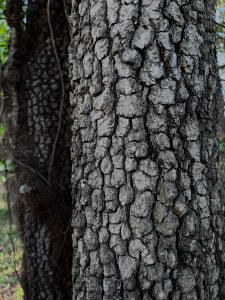
Certain species have proven particularly resistant to human intervention. In the 1890s, research stations in the US attempted to commoditize D. virginiana, the common persimmon—to no avail. The trees were too slow to grow, taking up to 10 years to bear fruit and 25 to reach peak productivity. The fruit is astringent, small, and seedy, making them undesirable as both a snacking fruit and for processing.
Persimmons, at heart, will always be wild fruit.
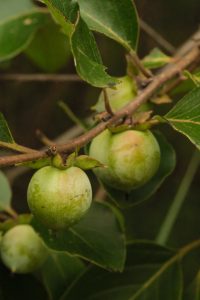
That is, of course, a convenient oversimplification. Persimmons have been cultivated for millennia, particularly in Asia but also in North America. However, historically the most common persimmons, astringent varieties that aren’t edible until soft ripe, are ill-suited for modern agricultural and commercial preeminence: Global production value of persimmons hit $2.9 billion in 2024, compared with $111.6 billion for the apple, that quintessential fruit.
A ripe astringent persimmon’s fragility relative to its weight makes it a poor candidate for long-distance shipping, and unlike an unripe supermarket tomato, whose only sin is tasting incomplete, an unripe persimmon remains stubbornly inedible.
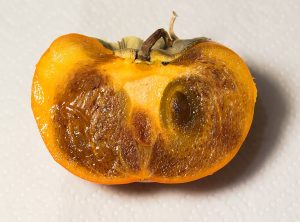
Even if it could travel to the consumer unscathed, a ripe persimmon tends to disturb the sensibilities of the modern consumer, delicious only when it dances on the knife’s edge of rot—dead ripe, a good astringent persimmon look mushy, bruised, past its prime with a blackened calyx.
However, there are varieties of non-astringent persimmons that have improved commercial properties, and it has become more common for supermarkets outside of California, which produces 99% of the total US persimmon crop, to carry small quantities of non-astringent persimmons, most commonly Diospyros kaki ‘Fuyu’.
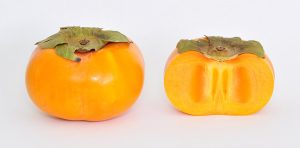
There are technically four types of persimmon astringency:
- Pollination constant astringent (PCA): Persimmons that become edible only when soft ripe, with or without seeds
- Pollination variant astringent (PVA): Persimmons that become edible only when soft ripe; seeds accelerate edibility somewhat
- Pollination variant non-astringent (PVNA): Persimmons that become edible when firm only if they produce seeds
- Pollination constant non-astringent (PCNA): Persimmons are edible when firm, with or without seeds
PCNA cultivars of persimmons were first documented in 17th-century Japan. Fuyu persimmons are PCNA. Most Fuyu trees are parthenocarpic (producing fruit without being pollinated), and their fruit have no seeds.
Common persimmons are PCA fruit. Whether they are pollinated or not, they will only become sweet when soft ripe. (Wild D. virginiana will less frequently produce parthenocarpic fruit than cultivars, rendering the PCA/PVA distinction somewhat trivial).
Truly non-astringent persimmons like Fuyu are a supermarket’s dream—no tannic purgatory, fruit that can be picked before ripe, and firm flesh well-suited for long-haul trucking. But—and here I deviate from scientific fact into my own gastronomic crusade—humanity’s triumph over those divine fruits was a pyrrhic victory. What we gained in commoditizing the persimmon, we lost in its delight on the senses.
Non-astringent persimmons are, in my opinion, boring. A one-dimensional, vague sweetness in a vessel that is neither crisp like an apple nor succulent like a peach—a diluted version of itself designed to be more consistent, less wild.
(Despite my obvious bias, there are, of course, many benefits to non-astringent persimmons, and many cultivars that are even quite tasty. Non-astringent persimmons can be harvested much earlier. The skins of ripe astringent persimmons tend to maintain their bitterness long after the flesh sweetens—not so with non-astringent varietals. And, with apologies to Apicius, the eyes eat first—non-astringent persimmons just look better.)
By contrast, how to describe a ripe astringent persimmon?
Half the joy must be in the uncertainty—the gamble you take when you pluck the first fruit of the season from the tree. Is it actually ready? You will never know so many gradations of softness as when lightly squeezing persimmons on a tree, waiting for just right. Twenty-four hour’s patience can be the difference between a sandpaper tongue and sweet ambrosia.
And then you take a bite.
No fresh fruit tastes so darkly sweet as one that lingers on the bough until well past autumn’s peak—molasses-like jelly hidden within a delicate, hazy wrapper. The echo of bitter tannins provides structure and depth for a sweetness that otherwise would surely overwhelm the senses, an alchemical transformation more elusive than turning lead into gold.
This is a persimmon.
II. Growing persimmons at home
If you want to partake in this autumnal miracle, you first need to identify your objective.
If you’re more interested in supporting native ecology than your own consumption, straight Diospyros virginiana, the common persimmon, is your best option. While the fruit are equally as delicious as other persimmons (if less juicy, almost date-like), they are generally quite small with large seeds. But common persimmons are a beneficial food source to a number of mammals and are host plants for luna moths and hickory horndevils. I have also seen cecropia moth caterpillars feeding on D. virginiana.
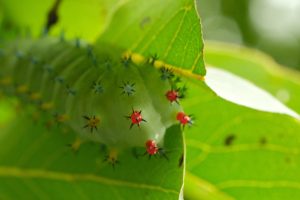
As noted above, D. virginiana does not reliably set parthenocarpic fruit, so planting multiple trees is required—at least one male and one female.
If you do not live near a nursery that sells native plants, you can start common persimmons from foraged fruit. The seeds can be cleaned of any flesh, left to dry for a day or two, and then cold stratified for at least 120 days in a damp medium like sphagnum moss. Soak the seeds for 2 to 3 days before sowing the seeds outside. Be sure to protect young seedlings from deer and other grazers come spring. Alternatively, to start the seeds in trays, the seeds must be sown in deep-plug trays; persimmon trees have deep taproots that make transplanting difficult.
Whether planting a young tree or sowing seed, common persimmons are hardy trees that can tolerate “a tremendous range of conditions from very dry, sterile, sandy woodlands to river bottoms to rocky hillsides and moist or very dry locations,” per the USDA. “It thrives on almost any type of soil.”
Flowers typically bloom in May on new wood. A severe late frost this year killed all of our pawpaw flowers, but our persimmons are flush with fruit.
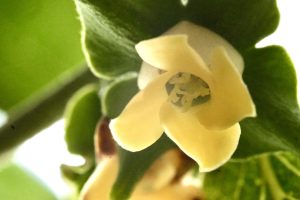
If you are more interested in epicurean delights, there are a number of options that will thrive in our hardiness zone (7b). Most of these cultivars sold at nurseries are grafted onto D. virginiana rootstock and can be given the same care.
The queen of all persimmon cultivars is unquestionably ‘Rosseyanka.’ One of the first hybrids between D. virginiana and the Asian persimmon D. kaki, it is the apotheosis of astringent persimmons. With late-maturing, sizable fruit, it is exceptional for both snacking and baking.
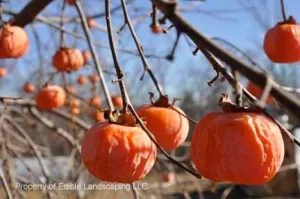
Other astringent varietals include:
- ‘Hachiya’ (the most common commercially grown astringent persimmon)
- ‘Great Wall Persimmon’ (famous for its almost box-like shape)
- ‘Nikita’s Gift’ (another American/Asian hybrid)
And for those who have failed to succumb to my zealous evangelizing, I offer some recommendations for non-astringent persimmons that are, admittedly, also very enjoyable:
- ‘Ichi Ki Kei Jiro’ (tree stays on the smaller side, making harvesting easier)
- ‘Izu’ (one of the earliest-ripening varietals)
- ‘Wase Fuyu’ (very young trees can produce fruit)
I, of course, will sing the praises of astringent persimmons—forever a lesson in patience, those warm-glowing will-o’-the-wisps in the winter landscape that have distilled an entire year’s worth of sweet into one untamed fruit.
Sources:
Ask IFAS. Japanese Persimmon Cultural Practices in Florida
Food and Agricultural Organization of the United Nations, Value of Agricultural Production
USDA Agricultural Research Service. ‘Bringing Persimmons into the Limelight’
North Carolina Extension Gardener Toolbox. Diospyros virginiana