Few crops reward the gardener quite like carrots. Pulling a bright carrot from the soil feels a bit like uncovering buried treasure. While carrots can sometimes develop a reputation for being difficult to grow, their needs are actually quite simple: loose soil, consistent moisture, and a little patience.
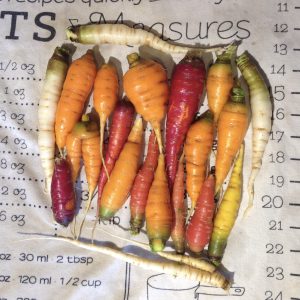
Photo: Alicia Gerdy
Whether you have a large garden, small raised bed, or pot on your balcony, growing carrots is a rewarding way to add fresh, homegrown flavor to your meals.
Carrots (Daucus carota subsp. sativus) are a commonly–grown root crop in home gardens. Members of the Apiaceae family, they are related to parsley, dill, fennel, and celery. While orange carrots are the most familiar, varieties are also available in shades of purple, yellow, red, and white, such as the cultivars/varieties ‘Cosmic Purple’, ‘Atomic Red’, and ‘Lunar White’.
Originally cultivated for their aromatic leaves and seeds, carrots are now prized for their sweet flavor and excellent storage potential. Rich in beta-carotene, fiber, and antioxidants, carrots are a nutritious addition to the home garden and can be enjoyed fresh, roasted, steamed, pickled, or preserved.
Virginia-grown Carrots
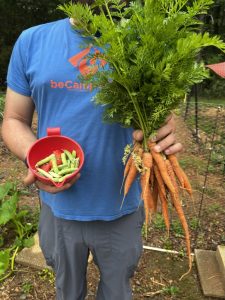
Photo: Alicia Gerdy
Carrots are a cool-season crop that can be grown successfully during both spring and fall in Virginia.
For a spring harvest, sow seeds outdoors approximately 2 to 4 weeks before the last expected frost date. In Central Virginia, this typically means planting from mid-March through April. Successive sowings every two to three weeks can extend the harvest season.
Many consumers find that fall-grown carrots produce the highest-quality roots. Seeds can be sown from late July through early September, depending on your location and the expected first frost date. The warm soil of late summer encourages germination, while the cooler temperatures of autumn support steady root development.
One of the benefits of growing carrots for a fall harvest is their improved flavor. As temperatures cool, carrot plants convert starches into sugars as a natural defense against freezing. This process results in sweeter, more flavorful roots. Carrots harvested after several cool nights—or even a light frost—are often noticeably sweeter than those harvested during the heat of summer.
In many parts of Virginia, carrots can be left in the ground well into late fall or even winter if protected with a thick layer of mulch. This allows gardeners to harvest fresh roots as needed while enjoying some of the sweetest carrots of the year.
Choosing a Site
Carrots grow best in full sun and well-drained soil with a pH between 6.0 and 6.8. Loose, stone-free soil is essential because the edible portion of the carrot develops underground. Compacted soil, rocks, and clods can cause roots to become forked, twisted, or stunted.
A sandy loam soil is ideal, but carrots can be grown successfully in most garden soils if they are amended with compost and thoroughly loosened before planting. Raised beds are often an excellent option, especially where native soils are heavy clay.
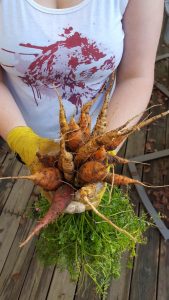
Photo: Alicia Gerdy
Common Varieties
- Chantenay – Best for shallow, heavy soils, these medium-light orange carrots can grow up to 2 ½ inches in diameter and up to 6 inches long.
- Imperator – What most think about when someone says “carrot,” these deep orange carrots can grow up to 8 inches long with a diameter of up to 1 ½ inches.
- Danvers – These deep orange carrots grow up to 7 inches long with a diameter up to 2 ½ inches. Harvest young roots, as older ones get quite tough and fibrous.
- Nantes – Bright orange carrots that grow up to 7 inches long and 1 ½ inches in diameter.
- Miniature and Oxheart – Great for heavy clay soil and container gardening, these carrots are shorter (up to 3 inches long) and stout (up to 2 inches in diameter).
Planting
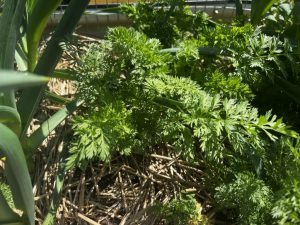
Photo: Alicia Gerdy
Carrots should always be direct-seeded into the garden. Transplanting damages the developing taproot and may result in misshapen carrots. Carrot seeds are small and germinate slowly, taking up to three weeks to emerge. Sow seeds approximately ¼ inch deep and keep the seedbed consistently moist during germination. For a continuous harvest, sow small plantings every two to three weeks throughout the spring or fall.
Tip: Because carrots tend to germinate slowly, radishes can be planted in-between the carrot seeds to mark the row, providing a quick crop from the same space while keeping the soil loose for the tender carrot sprouts.
Thinning Seedlings
One of the most important steps in growing carrots is thinning. Overcrowded seedlings compete for water, nutrients, and space, resulting in small roots. When seedlings reach about 2 inches tall, thin them so that plants are spaced 2 to 4 inches apart, depending on the variety (refer to your seed packet for proper spacing). Consider snipping the seedlings to be removed at soil level with scissors to avoid disturbing nearby roots. Although thinning may feel wasteful, it is often the difference between a harvest of pencil-sized roots and a crop of full-sized carrots.
Watering and Care
Uniform soil moisture is critical for producing sweet, crisp carrots. Inconsistent watering can lead to tough roots, cracking, splitting, and poor flavor. Keep the soil evenly moist throughout the growing season, especially during germination and root development. Mulch can help conserve moisture, suppress weeds, and moderate soil temperatures. Weed carefully around young seedlings, as carrot roots can be easily disturbed. Shallow cultivation is recommended to avoid damaging developing roots. Avoid excessive nitrogen fertilization. Too much nitrogen encourages lush foliage growth at the expense of root development.
Common Problems
Forked or Misshapen Roots
Usually caused by rocky, compacted soil, fresh manure, or root disturbance. If this happens, make sure to remove any obstructions in the soil before planting more carrots.
Small Carrots
Often the result of overcrowding, insufficient thinning, or poor soil conditions. To prevent this, thin your carrots when they’re about 2 inches tall according to the spacing noted on your seed packet.
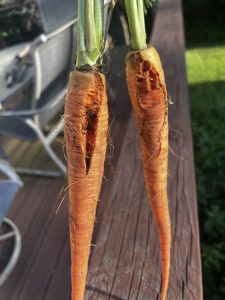
Photo: Alicia Gerdy
Cracked Roots
Typically caused by inconsistent watering, especially periods of drought followed by heavy irrigation or rainfall. Water regularly to help prevent this issue.
Bitter or Woody Carrots
Can develop when plants experience drought stress or are left in the ground too long during hot weather. Water regularly and harvest before the heat of summer to prevent this issue.
Green tops
Green tops can develop when roots are exposed to direct sunlight. To prevent this, make sure the carrot roots remain covered in soil. If you do happen to have green tops on some of your harvest, cut off the green part before eating as it will not have a good flavor.
Root maggots
Root maggots will tunnel into the root and eat their fair share, rendering the rest of the root inedible. The best prevention for this is crop rotation: do not plant carrots in the same spot as other below-ground crops, especially if you’ve had issues in the past. It is also helpful to use finished compost instead of animal manure.
Harvesting
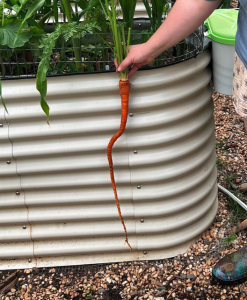
Photo: Alicia Gerdy
Most carrot varieties mature in 55 to 75 days, although carrots may be harvested at almost any size. Harvest only what is immediately needed, and allow the rest to grow until you need more, or until the weather is unfavorably warm.
To harvest, gently loosen the soil around the perimeter of the carrot with a garden fork before pulling. This reduces the risk of breaking roots, particularly in heavier soils.
Many gardeners find that carrots harvested after cool weather or a light frost develop an even sweeter flavor as the plants convert starches to sugars. Waiting to harvest fall-sown carrots until after the first frost will yield sweetest, succulent carrots.
Curing and Storage
Unlike many other cool-season and root crops, carrots do not require a traditional curing process. However, a few simple post-harvest steps will improve storage life.
After harvest:
- Remove the leafy tops promptly to prevent moisture loss.
- Gently brush off excess soil.
- Allow the roots to dry briefly in a shaded, well-ventilated location.
- Do not wash carrots intended for long-term storage.
For short-term storage, place carrots in the refrigerator.
For longer storage, keep unwashed carrots in a cool, humid environment just above freezing (32–40°F). Root cellars, cold rooms, or similar spaces work well. Properly stored carrots can remain usable for several months.
To Future Carrot Growers
When harvest day arrives, I encourage you to “stop and smell the flowers”, so to speak, for the aroma of a freshly harvested carrot is remarkable—earthy, sweet, and completely different from what most of us experience from store-bought carrots.
Growing your own food is rewarding in its own right, but harvesting something beautiful from your garden is especially satisfying. It’s truly rewarding to grow anything and I hope you find joy in growing your own carrots.
Featured Photo: Alicia Gerdy
References
University of Maryland Extension. “Growing Carrots in a Home Garden.”
University of Minnesota Extension. “Growing Carrots and Parsnips in Home Gardens.”
Oregon State University Extension Service. “Carrots.”
West Virginia University Extension. “Growing Carrots in West Virginia.”
Utah State University Extension. “Harvest and Storage: Root Crops.”
Montana State University Extension. “Carrots.”
Purdue Extension FoodLink. “Carrot.”
Va.Coop.Ext. Publication 426-422. “Root Crops.”