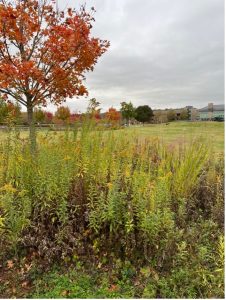
In mid-July of 2025, the woodland sunflowers and yarrow in the Piedmont Master Gardener (PMG) Demonstration Garden (below left) at Sentara Martha Jefferson Hospital (MJH) started to die.
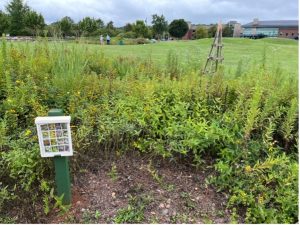
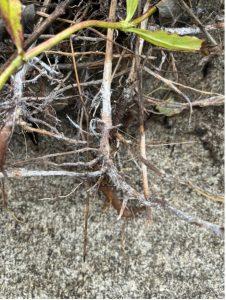
The symptoms were wilting leaves and new shoots, followed by the leaves curling up, turning brown, and eventually a dead plant (above right). When we started pulling the dead plants, we saw a white mat of fungus at the base of the plant and on the roots (right). We also observed many of the stems rotting at the ground.
We consulted with the PMG help desk and then sent samples to the plant clinic at Virginia Tech. The cause was Southern Blight (Sclerotium rolfsii), recovered from the lower stems and roots of the samples.
Southern blight is a soilborne disease affecting many plants, including vegetables and weeds. The pathogen thrives in warm (80–95°F), humid conditions, which perfectly described last spring in Albemarle County. The fungus produces small, mustard-colored sclerotia—small, spherical survival structures at the soil line that can survive in soil for lengthy periods. Initially, these are white but later turn a mustard color and are about the size of mustard seeds. The disease spreads via soil, plant debris, and equipment, and management relies on cultural practices, such as removing infected plants, controlling weeds, and avoiding infested sites. The contaminated soil or plant material should not be put in compost piles or used for other purposes unless it is going to be buried or the compost pile will reach temperatures of 122° F for 3-4 days. In some cases, vegetables have been bred to resist southern blight, and woody plants, aside from orchard trees, seem to be less susceptible.
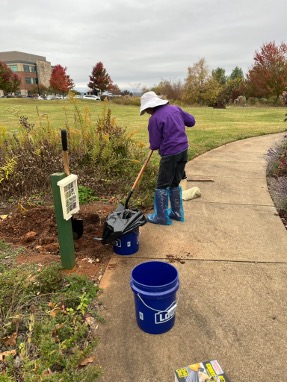
The fungus dies when buried deeply in the soil, so plant debris can either be removed (down to a depth of about 6″) or buried deeper than 6″. Although there are other measures, such as solarization (heat above 122°F can kill sclerotia), that are effective, we chose to remove and replace 6” of soil from the affected area at MJH (right).
To avoid spreading the fungus to other areas of the garden or taking it home to our own gardens, we wear boot covers in the section of the garden affected by southern blight and sterilize any equipment used in the MJH gardens. To kill the sclerotia, we use at least 6% sodium hypochlorite or household bleach without dilution, and soak tools for 10 minutes. We bag contaminated soil and all plant material and send it to the landfill.
The affected part of the garden, where new soil has been added, has been covered with cardboard and mulch to limit weed growth and avoid disturbance of the soil for this flowering season. We will be planting blight-resistant woody ornamentals for several years before planting more susceptible plants. We are planning to add a few native shrubs in the fall. Certain soil amendments, like aged compost, can be used in the bed to control southern blight disease and some fertilizers, such as calcium nitrate, may also be helpful. We can consider adding these supplements as we replant. We are cautiously optimistic that we have controlled the spread of the blight in the garden and that we will be able to replant with flowering plants over the next few growing seasons.
Sources:
An Overview of Southern Blight: Virginia Tech
Southern Blight Management for Woody Ornamentals: Tennessee State University
Southern Blight: University of Wisconsin