Horticultural oils are powerful tools that, in my humble opinion, aren’t employed by enough gardeners – myself included. My hunch is that the confusing, overlapping nomenclature surrounding horticultural oils is a hindrance to adoption. This article, then, will discuss how horticultural oils work, how they’re made, the meanings of the various terms describing them, and how to effectively and safely use horticultural oils in gardens and landscapes.
What are horticultural oils?
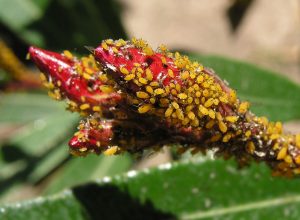
Horticultural oils are insecticides, miticides, and to a lesser extent fungicides. They work by forming a physical barrier that suffocates their targets. They can also suffocate insect and mite eggs. Horticultural oils cause dehydration, by disrupting insects’ and mites’ protective waxy cuticle. Finally, they can prevent insect feeding and egg deposition by changing the taste and/or texture of leaves.
Virtually all commercially-available horticultural oils, except for neem oil, are petroleum products. These oils are highly refined and filtered to remove phytotoxic, i.e. plant-damaging, components. They’re then mixed with emulsifying agents to disperse evenly in water.
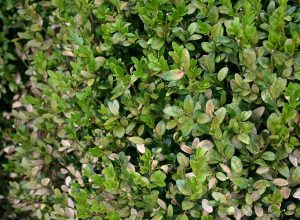
Vegetable oils like cottonseed oil – sometimes claimed to be the most effective plant-based horticultural oil – and soybean oil can be used as horticultural oils. Be cautious, though: their manufacturing processes aren’t designed to remove phytotoxic chemicals.
Horticultural oils work by direct contact with their targets, and they have low residual activity. In other words, an insect won’t be harmed by crawling on or eating a plant that had been treated with a horticultural oil; they simply don’t pick up enough of the oil to be affected. Moreover, horticultural oils evaporate quickly in warm weather and are easily washed away by rain or irrigation.
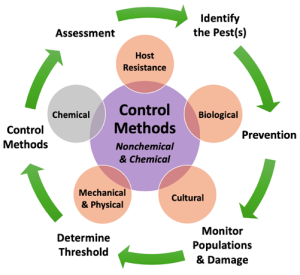
Their low residual activity means that horticultural oils can be applied precisely when and where there’s a problem, with few harmful spillover effects. This makes horticultural oils a great addition to an Integrated Pest Management (IPM) regimen, as described in this article by Piedmont Master Gardener Cathy Caldwell. The basic idea behind IPM is to identify a problem, then use the minimum intervention needed to reduce it to an acceptable level.
Terminology
Horticultural oils have been used for decades, if not centuries. Their manufacture has been fine-tuned over the years to reduce phytotoxicity, and this has changed how they are used. Their nomenclature, however, has not been updated, so it’s important to understand how these older terms relate to modern formulations and applications.
- Dormant oils are oils applied during the dormant season, usually in late winter or early spring before buds open. Historically, dormant oils were heavier, less-refined products that were phytotoxic if used during warm weather or on foliage. Modern horticultural oils are more highly refined, so the term “dormant oil” now often refers more to the timing and application rate than to a fundamentally different kind of oil. Many modern horticultural oils can be used during the dormant season, and some products labeled for dormant use may also be used during the growing season at lower rates. Always follow the product label, since dormant-season applications are usually mixed at higher concentrations than oils used in the growing season.
- Summer oils are used during warmer months. Back in the day, these were highly refined oils that didn’t harm plants in hot weather. Today, their composition isn’t meaningfully different from dormant oils. Follow the product label, since oils are typically used at lower concentrations in summer than in the dormant season.
- Foliar oils are another name for summer oils, i.e. oils that are applied when plants have leaves.
- Supreme oils are highly refined and are effectively the same as summer oils.
- Superior oils are highly refined and low in phytotoxic sulfur – which describes all modern horticultural oils. In other words, superior oils are equivalent to summer, foliar, supreme, and dormant oils. Oils once called superior oils are now mostly called “narrow range oils,” described below.
- Narrow range oils are distilled at a narrow temperature range, between 415°F and 440°F. This term is equivalent to, and has mostly replaced, “superior oil.”
- All-season oils can be applied any time of year. This is another more recent term, reflecting the reduced phytotoxicity of modern horticultural oils.
- Mineral oils are petroleum-derived. In other words, most horticultural oils are mineral oils, whether or not they’re labeled that way.
- Paraffin or paraffinic oils are petroleum-derived as well; this term is essentially synonymous with “mineral oil.”
- Spray oils are formulated with emulsifiers so they can be mixed with water and sprayed. Virtually every horticultural oil you’ll encounter in a store is a spray oil.
Manufacturers sometimes combine these terms in a confusing way, e.g. “all-season horticultural dormant spray oil,” but don’t be put off. The long and short of all this terminology is that all modern horticultural oils are more or less the same in terms of composition and time of application.
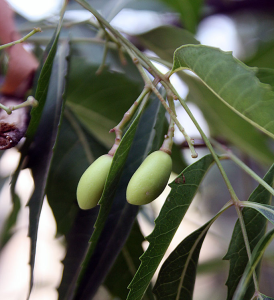
Neem oil
Neem oil is extracted from the seeds of the neem tree, Azadirachta indica, which as the name suggests is native to India and Southeast Asia. Neem leaves and seeds are full of compounds with insecticidal and fungicidal properties, and neem products have been used for centuries as a natural insecticide.
The insecticide azadirachtin is derived from neem. However, it’s important to note that azadirachtin is removed by the process for refining and clarifying neem oil. Azadirachtin can be bought separately, as a water-soluble powder. So neem oil works pretty much just like a petroleum-based horticultural oil, i.e. by suffocating and dehydrating its targets and disrupting processes like feeding and mating.
How to use horticultural oils
Always use personal protective equipment when spraying any pesticide: hat, eye protection, rubber or nitrile gloves, long sleeves and pants, and closed-toe shoes.
Horticultural oils are most effective when used against susceptible insects, mites, and diseases. Identifying pests and diseases is another key IPM principle: check your plants often, identify problems, and treat before they become serious. Examples of susceptible pests, from the Colorado State University Extension:
- Aphids, overwintering mites and lepidopteran eggs, and certain scale insects can be controlled by spraying in late winter/early spring, i.e. the dormant season.
- Summer or foliar sprays can control aphids, scale insects, eriophyid and spider mites, whiteflies, and leafhoppers.
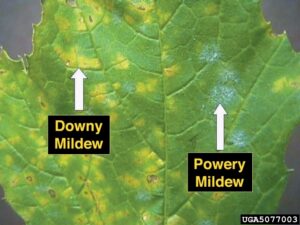
- Powdery mildew, discussed in this article by Piedmont Master Gardener Ralph Morini and shown in the photo at right, is the fungal disease most commonly treated by horticultural oils.
Read the label to check what pests and diseases are controlled by a particular product. The label will also tell you when to spray specific targets, and, as discussed below, how to dilute concentrated oils.
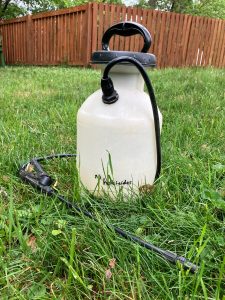
Thoroughly cover plants when spraying horticultural oils. This is critical because horticultural oils must completely cover their targets to be effective. Spray both sides of leaves, and spray into the junctions between leaves and stems where pests can hide.
Thorough coverage means that you’re likely to use relatively large amounts of horticultural oils. To reduce cost, I’d recommend buying concentrated oils and diluting them with water in a sprayer.
Another advantage of concentrates is that you can choose the dilution to fit the circumstances. For example, let’s say you’re spraying a scale insect infestation on a chilly day in early spring. Low temperatures mean the oil’s viscosity will be high, and it’ll be less likely to flow into and clog the insects’ breathing apparatus. You should use a more concentrated oil mixture – say 3%, or about half a cup of oil in a gallon of water. On the other hand, if you’re battling a summer aphid infestation, 1% oil – or about 2.5 Tbs in a gallon – will be sufficient. The product label will tell you what dilution to use against specific pests and diseases.
Precautions
Avoid harming pollinators and other beneficial insects with horticultural oils. Don’t spray when plants are flowering, for example. If you do spray a flowering plant, do it in the evening when bees and other pollinators are less active. Horticultural oils’ low residual activity makes it easy to avoid harming beneficial insects, by simply not spraying at times when direct contact with oils might be harmful. As with any pesticide, don’t let the spray drift onto sensitive plants (see below) or beneficial insects.
There are a few other times when you shouldn’t apply horticultural oils. In particular, don’t use oils in very hot weather, when even modern, highly refined horticultural oils can harm plants. The damage is caused by water stress, not phytotoxic impurities: oils disrupt the plants’ waxy cuticle and exacerbate the desiccation caused by the heat. Also avoid using oils during the first few weeks of cold weather in the fall, while plants are hardening off. The reason is the same: cuticle disruption and desiccation, which can harm the buds for the next year’s growth.
Finally, some plants are particularly sensitive to horticultural oils and shouldn’t be sprayed even in moderate weather. According to CSU, don’t use oils on black walnut, hickories, spruce, junipers/cedars, Douglas fir, maples (particularly Japanese and red maples), redbuds, smoke tree, and Cryptomeria (Japanese cedar).
Concluding thoughts: are horticultural oils organic?
When used properly, some petroleum-based horticultural oils can be organic. Narrow range oils, which I defined above, are listed by the Organic Materials Research Institute (OMRI) and the US National Organic Program (NOP) as permitted insecticides and miticides. However, narrow range oils can only be used organically if the grower has already used preventative practices like crop rotation and sanitation to reduce pests. The same goes for neem oil: it’s considered organic if used with the appropriate preventative actions.
References and further reading
Horticultural Oils (PDF) Cornell University Cooperative Extension Nassau County
Horticultural oils University of Connecticut Home and Garden Education Center
Horticultural oils – What a gardener needs to know University of Nevada Reno Extension
Insect control: Horticultural oils Colorado State Extension
Pesticide profile: Horticultural oils University of Maryland Extension
Spider mites Utah Plant Pest Diagnostic Lab
What should neem be used for on plants? University of New Hampshire Extension
Use of horticultural oils in agriculture and beyond: back to the future Georgia V. Baliota and Christos G. Athanassiou, University of Thessaly