Typical landscapes are designed in layers. The topmost or canopy layer consists of tall trees and large shrubs. The understory or middle layer is comprised of smaller trees and shrubs. The ground-hugging layer typically includes herbaceous perennials, annuals, and bulbs. So where do vines fit into this layered structure?
Vines are typically used to provide vertical interest in the landscape. Their role is to fill in the gaps between plants near the ground level and those in the understory and canopy layers of the landscape. Some of the longer vine species can climb up into the tallest trees, whereas some shorter or more diminutive vines sprawl or trail horizontally along the ground.
Besides providing color, texture, mass and vertical interest, vines also serve a functional purpose in the landscape. Depending on the vine species grown, they can provide shade or serve as a privacy screen to help hide trash cans, utility boxes, or other unsightly features from view. Flowering vines offer nectar and pollen for beneficial insect species. Birds often nest in vines and other small wildlife species can take refuge from the elements or seek safety from predators in a vine’s dense foliage.
BOTANICAL CHARACTERISTICS OF VINES
Vining plant species vary widely and may be woody, herbaceous, evergreen, or deciduous. Some vines are valued for their colorful floral displays. Others are grown for their foliage. Regardless of their obvious growth habits, vines exhibit several unique botanical characteristics that set them apart from other plant categories:
- They are scandent. Broadly defined, this means they evolved to climb, lean, or sprawl in their attempts to reach sunlight.
- They grow fast, with some reaching impressive heights in a very short time. As one extreme example, kudzu (Pueraria montana) can grow a foot per day.
- They typically have weak, flexible stems that need support of some sort to help them grow vertically.
- They don’t normally take up much space at ground level, but some can become quite massive as they grow upward and spread.
- Most vines have specialized botanical features that help them grasp, twine, or adhere.
VINE CLIMBING FEATURES
Vines grow toward the light by using a variety of climbing strategies:
- Tendrils. Botanically, these slender, flexible coiling organs are modified stems or leaves. When stimulated by touch (a process called thigmotropism), tendrils grab a point of contact such as a trellis, another plant, or even another stem from the same plant. At the point where the tendril makes contact, it exhibits low levels of auxins (phytohormones), which control stem elongation and directional growth. Auxin levels on the opposite side of the tendril are high, triggering those cells to grow longer causing the tendril to curve and form into coils. Passionflowers (Passiflora incarnata) and sweet peas (Lathyrus odoratus) are examples of vines equipped with tendrils.
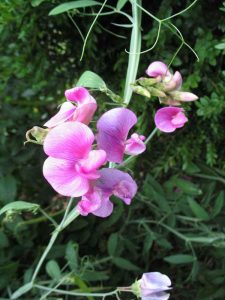
Sweet Pea Vine. Photo Credit: Missouri Botanical Garden Plant Finder - Twining stems. Instead of grabbing a point of contact like a tendril, a twining stem coils itself around a support. Morning glories (Ipomoea species), purple hyacinth beans (Lablab purpurea), and honeysuckle (Lonicera species) are examples of vines with twining stems. Fun fact: According to Linda Chalker-Scott, author of How Plants Work, some vines twine in a clockwise direction but more than 90% of vine species twine counterclockwise, forming a right-handed spiral. The botanical term for this elliptical twining motion is circumnutation. If you unwind a flexible young vine stem and then rewind it in the opposite direction, the stem will try to unwind itself in its effort to return to its original direction.
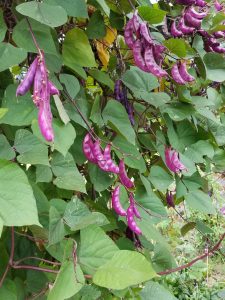
Purple hyacinth bean Vine. Photo Credit: Pat Chadwick - Rooting stems. Also called adventitious or aerial roots, these structures form along a vine’s stem above the surface of the soil and are therefore exposed to the air. They securely attach the vine to whatever surface it is climbing. Poison ivy (Toxicodendron radicans) and climbing hydrangea (Hydrangea anomala) are two examples of vines that use this particular climbing strategy.
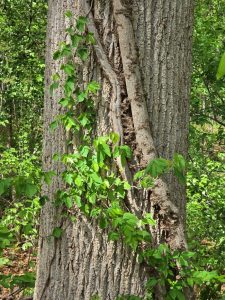
Poison Ivy. Photo Credit: Pat Chadwick - Adhesive pads. Also called adhesive discs or holdfasts, these features occur at the tips of some specialized tendrils and develop when the tendril touches a surface, such as brick, stone, a wall or tree bark. Contact with the surface stimulates cells at the tip of the tendril to divide and grow, forming a callus-like growth. The growth ultimately forms into an adhesive pad capable of adhering tightly to whatever it touches. Boston ivy (Parthenocissus tricuspidata) and Virginia creeper (Parthenocissus quinquefolia) are examples of vines with adhesive pads or discs.
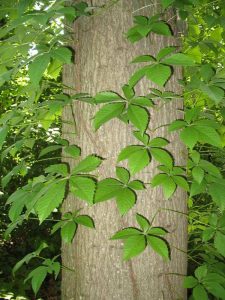
Virginia creeper. Photo Credit: Missouri Botanical Garden Plant Finder - Thorns and thorn-like structures. Although not very effective as climbing devices, thorns or prickles do help some vine species, such as climbing/rambling roses, greenbrier (Smilax rotundifolia) and Bougainvillea, latch onto other plant growth as they climb. Mile-a-minute vine (Persicaria perfoliata) stems have hooked barbs, which are more effective than thorns in aiding the vine to climb over other plants and vertical supports.
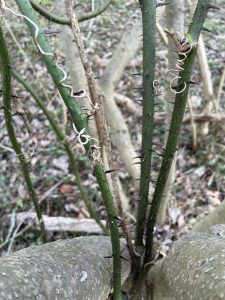
Greenbrier. Photo Credit: Missouri Botanical Garden Plant Finder
TIPS FOR SELECTING VINING PLANTS
Vining plants can be tricky to select for the landscape. Part of the problem is that vines typically have a small footprint at ground level but as they grow upward, they can spread and take up a great deal of room. So, it’s really important to keep the plant’s mature size in mind when selecting a vine and how its size might affect nearby plants.
Vines can also be tricky to select because many require a support structure, which can add expense and effort. Unless you plan for the vine to spread across a fence, or up a tree or even the side of your house, you may need to install a sturdy trellis to support the weight of the vine. American wisteria (Wisteria frutescens), for example, is a woody vine that can grow to be very heavy, requiring a very sturdy trellis to support its weight.
Before investing in a vine, make sure you have a clear concept in mind. For example:
- What type of vine do you want? Deciduous, evergreen, herbaceous (annual or perennial), or woody?
- Will it require a trellis? If so, how tall and wide does it need to be? Think in terms of the vine’s mature size. A 6’ tall trellis, for example, won’t support a vine that grows 10’ tall.
- Is the allocated space wide enough to accommodate the vine? This is particularly important to know if you’re considering a long-lived woody vine that may take up a lot of space.
- As it stretches up, will the vine grow into nearby trees or shrubs?
- Will it block access on nearby walkways?
- Will it block sun from nearby plantings?
- How much sun will it need? In other words, should it be a sun-loving or shade-loving plant?
- How will it fit into your existing landscape? Will it harmonize with nearby plantings, dwarf them or encroach on them?
- Other than being decorative, will it be used for a practical purpose, such as screening trash cans or for privacy?
- How much maintenance will the vine require? Some vines require regular pruning to contain their overall size, or reduce the weight of heavier, woody species, or enhance flowering.
Once you have addressed those questions, research potential vine choices to make sure they match the criteria you have identified. Choosing a specific species is your first step. Keep in mind that growth habit, blossom color, foliage shape, or size of a cultivar or variety may differ from the straight species.
EXAMPLES OF VINES SUITABLE FOR MID-ATLANTIC GARDENS
If you want to experiment with vines but don’t want to make a long-term commitment, consider growing an annual vine such as:
- Black-eyed Susan vine (Thunbergia alata) – Climbs 6’ to 8’ by twining.
- Cardinal vine (Ipomoea x sloteri). Climbs 6’ to 12’ by twining
- Cup and saucer vine (Cobaea scandens). Climbs up to 20’ using tendrils.
- Mandevilla (Mandevilla species). Climbs up to 20’ by twining
- Moonflower (Ipomoea alba). Climbs up to 20’ by twining
- Purple hyacinth bean (Lablab purpureus). Climbs up to 15’ by twining.
- Snail vine or corkscrew flower (Vigna caracalla). Climbs 12’ to 30’ by twining.
- Sweet pea (Lathyrus odoratus). Climbs 3’ to 8’ using tendrils.
- Sweet potato vine (Ipomoea batatas). Technically not a vine, this ornamental plant typically spreads horizontally to fill an area of about 3’. It can also be trained onto a trellis for a vertical effect.
Of the many perennial vines available, a few native suggestions include:
- American wisteria (Wisteria frutescens). Less aggressive and slower growing than its non-native Asian relatives. It climbs by twining from 25’ to 40’ and blooms on new spring growth. Prune back yearly in fall to late winter to control its size.
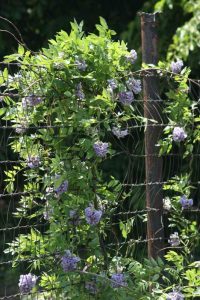
American wisteria. Photo Credit: Missouri Botanical Garden Plant Finder - Crossvine (Bignonia capreolata) uses tendrils to climb 15’ to 50’, depending on the species or cultivar, and blooms on old wood. Prune immediately after it finishes flowering to avoid removing next year’s flower buds.
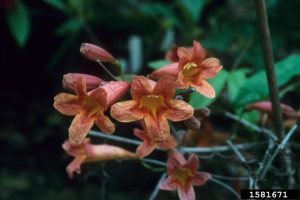
Crossvine. Photo Credit: John Ruter, University of Georgia, Bugwood.org - Passionflower vine (Passiflora incarnata) uses tendrils to climb 10’ to 15’ and may sucker aggressively. It is the host plant for the variegated fritillary butterfly. Bumblebees love it as well.
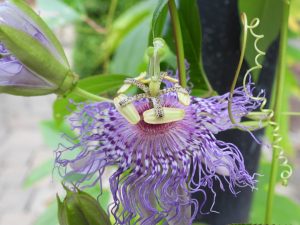
Passionflower vine. Photo credit: Missouri Botanical Garden Plant Finder - Pipevine or Dutchman’s pipe (Aristolochia macrophylla) climbs 20’ to 40’ by twining. It is a caterpillar host for the pipevine swallowtail butterfly (Battus philenor).
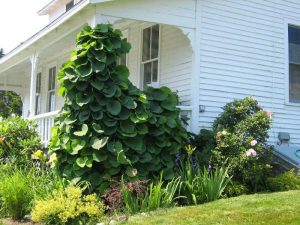
Pipevine. Photo Credit: Missouri Botanical Garden Plant Finder - Trumpet, or coral, honeysuckle (Lonicera sempervirens) climbs 10’ to 20’ vine by twining. Prune it in autumn or late winter. Flowers appear on the year’s new growth. It is a good choice for growing along a fence.
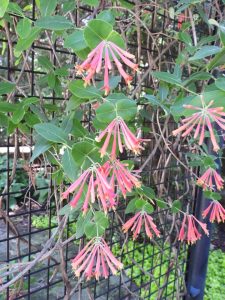
Coral honeysuckle. Photo Credit: Missouri Botanical Garden Plant Finder - Virginia creeper (Parthenocissus quinquefolia) grows 5’ to 40’ and climbs by tendrils which end in adhesive discs. It displays intense red foliage in autumn and is a host plant for Virginia creeper sphinx moth and Achemon sphinx moth larvae.
Virginia creeper. Photo Credit: Missouri Botanical Garden Plant Finder
AVOID INVASIVE VINES
Although garden centers are becoming more careful about not selling invasive species, occasionally you may find one for sale. Invasive vine species can outcompete native species by climbing over and smothering them, girdling them, blocking the sun from them, or crowding out young native seedlings. Some examples of invasive vines to avoid include:
- Asiatic bittersweet (Celastrus orbiculatus)
- English ivy (Hedera helix)
- Japanese honeysuckle (Lonicera japonica)
- Porcelain berry (Ampelopsis brevipedunculata)
- Wintercreeper (Euonymus fortunei).
- Wisteria (Chinese and Japanese varieties).
Featured Photo: Lonicera sempervirens ‘Major Wheeler’. Photo: Pat Chadwick
SOURCES:
How Plants Work (Chalker-Scott, Linda, 2015)
Vertical Gardening (Fell, Derek, 2011)
Annual Flowering Vines, Iowa State University Extension and Outreach
Climbing Vines in Coastal Virginia, James City County Williamsburg Master Gardener Association (By Elizabeth McCoy, Updated February 18, 2026).
Edible Landscape Species — Shrubs, Vines and Groundcovers, Virginia Cooperative Extension Publication SPES-317
Selecting Landscape Plants: Ornamental Vines, University of Missouri Extension
Perennial Vines: Friend or Foe?, PennState Extension
Illustrated Glossary of Horticultural and Botanical terms, Master Gardeners of Northern Virginia
Vine Selections for Landscaping, Clemson Cooperative Extension
Vines, University of Illinois Extension