Every year, billions of songbirds such as warblers, thrushes, orioles, and sparrows journey from their breeding grounds in North America to their winter homes in the Caribbean, Central America, Mexico, and South America. They travel back again to North America in the spring. We often see these traveling birds in our yards but are unaware that bird migration is one of the most amazing and dangerous phenomena of the natural world.
CHARACTERISTICS OF MIGRATION
Birds migrate in response to both environmental and genetic cues. They do not travel to escape cold temperature, but rather to find food. For example, some species live and breed in Canada and the Arctic during summer, when insects are abundant. Spring and summer daylight hours are longer at higher latitudes, giving birds more time to forage. Then, they move south to their winter homes as temperatures drop and food supplies diminish. In spring, they reverse this route to breed when warmer temperatures return, bringing insects to life and providing the food needed to sustain adults and their young. Changes in day length trigger hormonal signals that indicate it is time to begin moving. For many species, migration is an innate behavior, allowing young birds to move to an area they have never seen.
Birds migrate in flocks at night when the air is cooler and calmer and there are fewer predators. They use the sun, stars, and the earth’s magnetic field as well as visual landmarks to navigate thousands of miles. Birds tend to be loyal to their breeding and wintering sites so return to the same areas year after year.
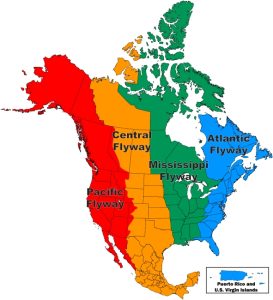
In North America, birds travel within four main routes or flyways. In the western half of the U. S., migration is linked to the air and water temperatures of the Pacific Ocean. In the eastern half of the U. S., airways flow east to west, sending warm air from the tropics northward and cold polar air to lower latitudes. These air waves affect weather patterns, cuing birds to start migrating. Flying in flocks, they periodically stop to rest and refuel before continuing their journey. The Atlantic flyway spans an area from Greenland to South America, covering states from Maine to Florida. Central Virginia is a vital segment of this flyway. In the spring, from March to May, we see large numbers of birds passing through moving north, stopping to rest and refuel, or staying to breed. From August through November, we see those making their southward journey.
TYPES OF BIRD MOVEMENT
Long-distance migrators, some weighing only a few ounces, travel between hemispheres. The Arctic Tern has the longest bird migration, flying across the ocean from its breeding grounds in the Arctic to its winter home in the islands of Antarctica. These small birds skim the ocean to feed on fish and small sea creatures, occasionally resting on patches of ices. Barn swallows are another long distance traveler, moving from New York and other points north to Argentina and Chile. Other birds migrate short or medium distances, sometimes moving from higher to lower elevations or from one state to another. Songbirds do not travel non-stop, but make stopovers to rest, feed, and refuel. Habitat in these stopover sites is just as important as the breeding sites to bird conservation. Last winter, in late January, when the temperature was frigid and snow was on the ground, I saw a flock of about 50 robins perched in the branches of my backyard tree. Aren’t robins the first sign of spring and wasn’t it too early for them to be here? I realized these robins were making a stopover on their way to their spring breeding ground. Robins change their eating habits in the winter, sustaining themselves on nuts and berries. When the ground warms up in the spring and worms and insects become available, they become carnivores to feed themselves and their young. Some species are permanent residents in an area. Birds that eat seeds, berries or insects hiding in bark can find enough food to stay through the winter if those resources are available. Permanent residents, such as chickadees, are well-insulated and can survive the cold. In addition to chickadees, I see mockingbirds, cardinals, titmice, and crows in my yard all year. Northern Cardinals are generally non-migratory and have expanded their range, perhaps due to people filling bird feeders and making food available all winter. Some birds that summer in the far north find the mild winters of Central Virginia hospitable. Look for winter residents such as the dark-eyed junco in your yard in the winter. These snowbirds spend the winter here, heading north in the spring for their breeding grounds.
NEW FINDINGS IN MIGRATION RESEARCH
Scientists are intrigued with the complexity of bird migration. They know migration involves neurological, physiological, and behavioral traits. New tools are helping them decipher this fascinating mystery.
Radar and weather maps have long been used to detect and understand patterns and numbers of bird migration. Recent research from the University of Maryland Center for Environmental Sciences Appalachian Laboratory suggests there might be social aspects driving migration along with innate qualities and environmental cues. Daylight allows young birds to learn behavior by observing other birds. What happens at night when bird flocks are flying? Over three years, researchers made 18,300 hours of acoustic recordings at migration stop-over sites in 26 sites in North America. Individually evaluating these recordings would have taken years, but by using AI tools, the scientists were able to discern verbal associations between species. They think birds calling at night seem to be signaling to other migrating birds. These “conversations” might be related to navigation or stopover habitats. At any rate, they indicate interactions among species previously unknown that could help understand bird migration.
There is a genetic component to migration and scientists have identified a single gene at work. Researchers at Penn State and the Cornell Lab of Ornithology found one gene that is associated with the migrating behavior of blue and golden-winged warblers. They reached this conclusion by combining the science of genome sequencing with tracking technology. These two warblers are genetically similar and breed in the Midwest and Northeastern United States. They winter in Central and South America. Researchers attached geo-locators with light sensors to the birds and then recorded the light levels of their environment in the wintering sites. They took genetic samples from the birds that wintered in Central America and those that wintered in South America and noted the differences. Most differences occurred on the birds’ Z chromosome and only one gene was present in this region. As of yet, the scientists do not know the exact role of this gene, but in humans it is associated with a neurodegenerative disorder that affects movement. They think this gene might be involved in clearing free radicals that build up during a long bird migration. This insight is a stepping stone to understanding more about migration in warblers and possibly other birds.
THREATS TO BIRDS
According to Cornell Labs, one third of all birds in the U. S. and Canada have disappeared in the last 50 years. This is a loss of billions of birds among hundreds of species. This decline has been sharpest in the eastern half of the country where population is dense. The steepest declines in bird populations have been among some of our familiar backyard songbirds: blackbirds, sparrows, orioles, blue jays, grosbeaks, and juncos. Because the decline is slow and we still see these birds, we don’t realize how prolific they used to be. Causes of the decline include:
Habitat loss: The biggest factor causing the decline of bird populations is the inability of our developed landscape to nurture birds. Increased urbanization as well as expanding agricultural areas have reduced the acres of both forest and grasslands that are important to birds for food and habitat. Development has also constricted stopover areas, funneling too many birds into one area and therefore lessening the amount of food available and creating competition among the birds.
Light pollution: The cycle of daylight and dark are important to the rhythms of wildlife, especially birds. When artificial light floods the night sky, migrating birds cannot use the stars for navigation and are instead drawn to artificial lights. Trapped by artificial light, they circle and circle until their energy is depleted. Tired, they are at more risk of colliding with buildings. Window strikes at night kill tens of millions of birds annually. Cloudy nights are particularly challenging as birds fly at lower altitudes and lights reflecting on clouds disorient the birds. Even birds that are seed and berry eaters as adults, feed their young insects and caterpillars. Lights impact the survival of moths and other insects that birds rely on for food, making sustenance more difficult. See Creating Habitat for Lepidoptera, Piedmont Master Gardeners for more information.
Climate change: Bird migration evolved over millennia as a response to the changing weather. Food availability and climate conditions have always been variable from area to area. Climate change, however, is making severe storms more common and in turn, disrupting habitat. In response, scientists are studying how the rapid climate change and severe weather patterns of today are affecting bird migration. Severe storms or drought in an area can affect food sources and so can disrupt normal migration patterns. Typical stopover sites might be unusable. As hurricane season expands, birds traveling across the Gulf of Mexico and the Caribbean from Central and South America might encounter a raging storm. Birds are flexible and adaptable creatures who respond to their environment. But can they adapt enough to face this weather changeability along with decreasing habitats? Some adaptation is already taking place. Think of the cardinals who have broadened their winter range. Historical records show that warmer temperatures are making food available sooner so birds are arriving earlier in breeding areas in spring and breeding sooner than they did in the past. On the other hand, birds might delay their departure from their winter homes or from stopover spots. This could enable them to find a mate and raise a successful clutch of chicks in a new area. In the fall, warmer temperatures might keep insects available longer and delay birds’ departure date. In turn, with food available longer, resident species may thrive and increase their populations. These factors might lead to an increase in populations is some areas, but there is a downside. As migratory species stay longer in breeding areas, they will be competing with resident species for food and nesting sites that are already becoming scarce. It is hard to say whether climate change will add to the decline of birds due to competition, but the shifting temperatures are expected to cause a decline in migratory activity and modify the composition of songbird species in an area.
HELPING MIGRATORY BIRDS
With the loss of habitat, major efforts to restore and maintain landscapes are needed. To date, most large conservation efforts, such as they are, concentrate on breeding ground habitats. Scientists now realize that similar efforts must also be made to restore and conserve stopover spots. Using weather radar, scientists can map the habits of migrating birds to see where they stop. These studies show there are bottlenecks where diminished habitat cause birds to congregate in a region too small to handle the population. As many birds are traveling across the Caribbean and Gulf of Mexico, the panhandle of Florida and shores of coastal states are major stopping points. Nearly exhausted from their trip over the water, birds finally stop to rest and find food. Due to development there is limited habitat, the area is congested, and food more difficult to find. With climate change causing intense storms and destroying bird habitats, it is important that we be more intentional about how we use the land. Conservationists are looking to find ways to increase and protect the habitat in stopover as well as breeding areas.
BACKYARD HABITATS: WHAT YOU CAN DO
Not all conservation efforts must be done on a large scale. With the decline of native forests, urban parks and suburban backyards have become important stopping and breeding places for migrating birds. Here is how the homeowner can help:
Reduce your lawn and install native plants. Adding native plants to your property is the best effort you can make to help birds. North American birds have evolved along with native plants which provide the food that native birds eat. Non-native plants might produce berries, but our birds cannot necessarily eat them. A perennial garden of native flowering plants in the summer will provide food for butterflies who will mate and produce the caterpillars that feed baby birds. Adult birds will in turn eat their seeds in the fall. Watching a goldfinch light on a coneflower and eat the seeds is one of the joys of late summer. Native trees and shrubs will provide berries that sustain both resident and migrating birds in the fall and winter. Thickets of shrubs provide shelter and nesting places. See Plants that Feed Wildlife in Winter, Piedmont Master Gardeners for more information on plants that provide food for wildlife.
Offer water throughout the year, even in winter. Be sure to keep birdbaths clean and free of algae.
Bird feeders have pros and cons. When supplied with suitable food, bird feeders provide nourishment to visiting birds and enjoyable birdwatching for the homeowner. However, feeding birds can be frustrating and expensive. In areas where squirrels are prolific (and that is most areas), you might be feeding mammals as well as the birds. The eastern U.S. is known for black bears who are going to their winter dens later in response to warmer temperatures. Bears are drawn to feeders and can topple and destroy the apparatus. Most importantly, if you have feeders, keep them clean and filled with fresh food to avoid the growth of fungus and disease that can be harmful and transmitted bird to bird.
Turn off outside lights. Dark skies help birds navigate so restrict artificial lighting. Use motion sensors or timers on necessary lights and point any lights downward. Keep path lights low to the ground. Decorative lighting of trees and shrubs is detrimental to birds. LED lights are widely used for their many advantages but emit bright white or blue lights that are disconcerting to navigating birds; warmer lights are less harmful. Keep lights as dim as possible and draw blinds at night so windows remain dark.
Keep cats indoors. Cats are hunters and are one of the largest causes of bird mortality.
Each of these is a simple fix that can create an environment conducive to the survival of our avian friends.
Resources
Climate Change Effects on Migratory Birds, University of Minnesota Extension
Mapping Bird Migration, University of Delaware
Millions of Birds Fly “Highways” Across the U.S. – and Their Migration Routs are Breaking Down, Binghamton State University of New York
New Insights Into the Genetic Basis of Bird Migration, Penn State
Robins Flocking on the Way North, Virginia Department of Wildlife Resources
Songbirds Socialize in the Wing During Migration, University of Maryland Center for Environmental Studies
Threats to Birds: Collisions (Nighttime Lighting), US. Fish and Wildlife Service
Vanishing: More Than 1 in 4 Birds has disappeared in the Last 50 Years, Cornell All About Birds
Feature Photo
Blackbirds by David Cobb