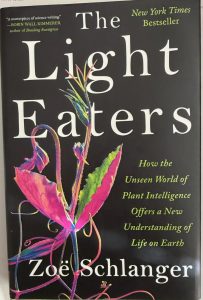
 At first glance, I assumed that The Light Eaters was a science fiction novel. And some of its critics would probably say that’s about right, that this nonfiction book about plant consciousness by Zoe Schlanger is mostly fiction, not science. That’s because plant scientists are in deep disagreement about whether plants are capable of consciousness. But as I began to read the book, its evenhanded exploration of this controversy won me over. Oh, and there was also the author’s way with words — as lyrical as poetry — which made her the perfect guide not only into this scientific debate but also into the many wonders to be observed in the plants around us.
One of the compelling elements of this book is the author’s reporting on the many research papers about plant “behaviors” — dare I call it that? If you’ve ever struggled to read scientific research articles, you’ll be as thrilled as I was that the author had done all that struggling herself — and then very kindly translated the articles into terms we lay readers can easily grasp. And oh, the things that go on in the plant world! I had no idea!
For just one example, consider this experiment: scientists attached guitar pickups to one group of plants, the pickups being tuned to the frequency of a cabbage white caterpillar chewing, while the control group’s pickups were silent. The plants which were exposed to the sound of a chewing predator produced defensive compounds in their leaves, while the control group plants did not! Can plants hear? And how would that happen? The author expertly explains the possibilities and the research supporting them. Other chapters examine research on plant “behaviors” that suggest they have memory, vision, and the ability to communicate.
And guess who pondered these questions long ago? Darwin. That’s right, as this book explains, Charles Darwin — after completing his work on evolution — became fascinated by plants and spent years exploring the capacities of plants. As the author explains:
Over the course of dozens of experiments that led to several books, Darwin observed how plants moved with remarkable athleticism, albeit very slowly . . . how they sometimes produced curious, irregular versions of themselves . . . and how carnivorous plants used tricks to lure and eat insects . . .
* * *
The Power of Movement in Plants, his second to last publication, was an inquiry into why plants moved the way they did. It was filled with experiments on plant roots, done alongside his son Francis. The conclusion they came to was startling. The very end of a plant’s root, he wrote, is covered with an unassuming cuticle that seems to be a command center . . .
* * *
Moisture, nutrients, obstacles, dangers: the root cap was sensing them all, sorting and steering accordingly. Darwin called it a “root-brain.”
—The Light Eaters, p. 44
If you too are fascinated by plants, you’ll love this book. And if you want to learn more about the “plant intelligence” debate, you’ll definitely want to read this book. It’s a both a pleasure and a learning experience, all neatly wrapped up in beautiful prose.